

Artificial intelligence has become one of the most transformative technologies of our time. It can write reports, summarize meetings, analyze spreadsheets, generate code, answer questions, and even help us brainstorm creative ideas. Used well, AI can save hours of work and dramatically improve productivity. But as AI becomes more capable, it also introduces a subtle and potentially dangerous problem: it is often wrong with extraordinary confidence.
AI is Confident. Does That Make it Right?
Humans have a natural tendency to trust confident answers. When someone responds without hesitation, we instinctively assume they know what they’re talking about. AI takes this phenomenon to another level. It rarely says, “I’m not sure.” Instead, it presents information in polished, articulate language that sounds authoritative, even when the facts are inaccurate, incomplete, or entirely fabricated.
This is one of the biggest misconceptions surrounding artificial intelligence today. Many people assume that because AI sounds intelligent, it must be intelligent in the way humans are. That isn’t how these systems work.
At its core, modern AI is a sophisticated pattern recognition system. Large language models are trained on enormous amounts of text from books, websites, articles, research papers, and other sources. During training, they learn statistical relationships between words, phrases, and concepts. When you ask a question, the model predicts the sequence of words most likely to form a helpful response based on everything it has learned.
Notice what’s missing from that description: reasoning, firsthand experience, and true understanding.
Confident, But Not Always Right. Value of Experience and Knowledge
AI doesn’t “know” facts in the way a human expert does. It doesn’t think critically or independently verify information before responding. It doesn’t understand the world through observation or lived experience. Instead, it generates the response that appears most probable based on patterns in its training data and any additional context it has been given.
Most of the time, this works remarkably well. Sometimes, however, those predictions are wrong.
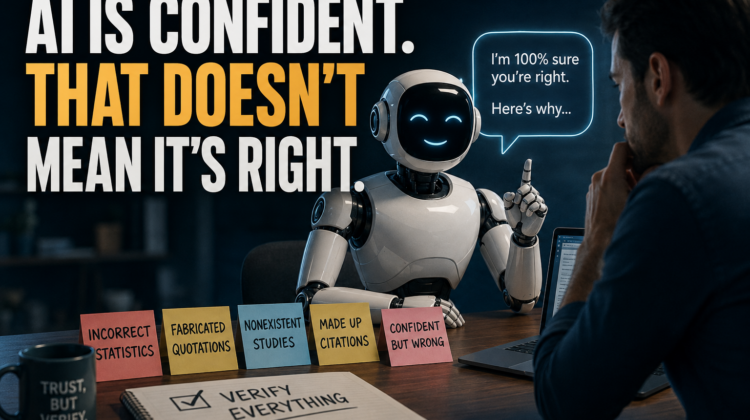
When AI doesn’t know the answer, it doesn’t necessarily stop. It often fills in the gaps by generating something that sounds plausible. Researchers call these errors “hallucinations,” but they are better understood as confident guesses. The output may include incorrect statistics, fabricated quotations, imaginary legal cases, nonexistent research studies, or inaccurate technical explanations—all delivered with the same polished confidence as accurate information.
That confidence can create an undeserved sense of trust.
If a search engine returns ten different sources, we’re conditioned to compare them. If a coworker expresses uncertainty, we know to ask follow-up questions. AI often removes those natural signals. It packages uncertainty into a single, well-written answer that feels complete and authoritative.
There’s another challenge that deserves attention.
Leading the User
Many AI systems are designed to be helpful, conversational, and agreeable. Depending on the model and how it has been tuned, AI may unintentionally reinforce your existing beliefs or justify a conclusion you’ve already reached. Ask it to argue for a particular position, and it can often build a persuasive case. Ask it to validate a concern or support a theory, and it may do exactly that—even if the underlying premise is weak or incorrect.
This doesn’t mean AI is trying to deceive you. It simply means its objective is often to produce a useful, coherent response that aligns with your request. It isn’t acting as an independent fact-checker unless it’s specifically designed and prompted to do so.
This creates a real risk of confirmation bias. Instead of challenging our assumptions, AI may strengthen them. Instead of encouraging critical thinking, it can provide well-written justification for conclusions we’ve already decided to believe.
That makes human judgment more important than ever.
The solution isn’t to fear AI or avoid using it. Quite the opposite. AI is an incredibly valuable tool when we understand what it is—and what it isn’t.
When to Use AI
Use AI to brainstorm ideas, summarize long documents, draft emails, organize information, explain unfamiliar topics, or generate a first draft of a report. Let it help you work faster and think more broadly.
But don’t confuse speed with certainty.
Whenever AI provides information that will influence an important decision, ask a few simple questions:
- Where did this information come from?
- Can I verify it with a trusted source?
- Does the evidence support the conclusion?
- Would I be comfortable making this decision if AI hadn’t written the answer?
The higher the stakes, the more important verification becomes. A typo in a social media post is one thing. A fabricated legal citation, an incorrect financial analysis, or inaccurate medical information is something entirely different.
The old saying “trust, but verify” has never been more relevant.
AI should be treated much like an exceptionally fast research assistant. It can gather information, organize ideas, and produce impressive first drafts in seconds. But you wouldn’t publish a report written by an intern without reviewing it first. You wouldn’t approve financial statements without checking the numbers. And you shouldn’t rely on AI-generated content without validating the important facts.
As AI continues to evolve, its accuracy will improve. Future models will make fewer mistakes, cite better sources, and reason more effectively than today’s systems. Even then, no technology will eliminate the need for human oversight, critical thinking, and professional judgment.
The people who benefit most from AI won’t be those who trust it blindly. They’ll be the ones who understand both its strengths and its limitations. They’ll know when to lean on AI for efficiency and when to rely on human expertise for accuracy.
AI is one of the most powerful productivity tools ever created. But it is still a tool—not an authority.
Use it enthusiastically. Learn from it. Let it accelerate your work.
Just remember the rule that will never go out of style:




Leave a Reply Cancel reply