

Beautiful, comprehensive documents that nobody reads are not winning.
Here’s a conversation that happened last week between a VP of Sales and their Marketing Director:
Marketing: “I created this great one-pager for the field team!”
VP: “I like it. It’s great. But you can’t give that to somebody and expect them to know what to do.”
That exchange captures the central tension in field enablement. Field teams won’t use documents that are too long. Field teams can’t execute from documents that are too short. So, what works?
What Progressive Distributors Are Doing
Distributors who achieve real field adoption follow a pattern, and it’s not what you’d expect. Here are three approaches that are getting used.
-
The Iteration Method
The problem: You create a comprehensive sales guide. It covers everything. It’s 47 pages of brilliance. Nobody reads it.
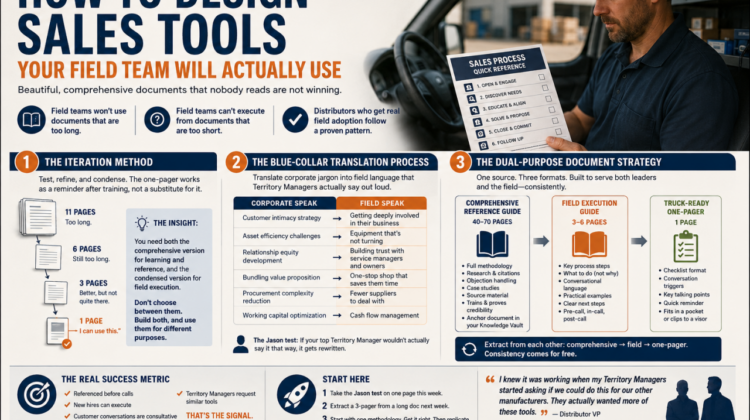
One HVAC distributor’s Carrier system sales process document went through four rounds before it landed. The first version ran eleven pages, covering the full methodology, complete product knowledge, and detailed objection handling. Territory Managers called it too long.
The second version cut it to six pages, condensed to key points with the background theory removed. Still too long, they said.
The third version came down to three pages, just the essential process in bullet form. Better, but not quite there.
The fourth version was a single page: a pure execution checklist in truck-ready format. That’s when Territory Managers said, “I can use this.”
But here’s the insight: the VP was right all along. That one-pager was great, but you couldn’t hand it to someone who’d never been trained and expect them to execute.
The one-pager works as a reminder after training, not a substitute for it. You need both the comprehensive version, for initial learning and reference, and the condensed version, for field execution. Don’t choose between them. Build both, and use them for different purposes.
-
The Blue-Collar Translation Process
The problem: Your sales methodology sounds like it was written by MBAs for MBAs, and field teams speak a different language. When leadership talks about “customer intimacy strategy” and “asset efficiency optimization,” Territory Managers hear corporate buzzword bingo.
What’s working is a systematic translation process that converts corporate language into field language:
| Corporate Speak | Field Speak |
| “Three fundamental economic forces” | “Three big problems contractors face” |
| “Asset efficiency challenges” | “Equipment that’s not turning” |
| “Customer intimacy strategy” | “Getting deeply involved in their business” |
| “Relationship equity development” | “Building trust with service managers and owners” |
| “Bundling value proposition” | “One-stop shop that saves them time” |
| “Procurement complexity reduction” | “Fewer suppliers to deal with” |
| “Working capital optimization” | “Cash flow management” |
The process is straightforward. Write the methodology in whatever language comes naturally, often corporate or theoretical. Go through it line by line and ask, “How would Jason actually say this to a customer?” Rewrite it in that language, then test it with actual Territory Managers by asking whether they can say it in a customer conversation without feeling weird.
One distributor calls this “the Jason test.” If their top Territory Manager wouldn’t actually say it that way, it gets rewritten.
The result is Territory Managers who can confidently discuss equipment turnover, cash flow, and strategic partnerships, because they’re using words that feel natural instead of corporate jargon they’re embarrassed to say out loud.
-
The Dual-Purpose Document Strategy
The problem: field teams need simple, and leadership needs thorough. One document can’t satisfy both. The fix is building everything to serve two masters at once, then extracting one document from the other so they stay consistent.
The complete reference guide runs 40 to 70 pages and carries the full methodology, theoretical foundation, research citations, objection handling, case studies, and source material. It proves credibility to leadership, trains new hires, and serves as the deep-dive reference and the source for everything else. It serves as an anchor document in your Knowledge Vault.
The field execution guide runs 3 to 6 pages, pulled directly from the comprehensive version. It keeps the “what to do” and drops the “why,” written in conversational language with practical examples and clear next steps. It’s built for pre-call prep, in-call reference, and post-call follow-up.
The truck-ready one-pager is pulled from the field execution guide in checklist format, with conversation triggers and key talking points. It’s the quick reminder that fits in a pocket or clips to a visor.
The key is not creating these three separately. Extract them from each other: comprehensive guide to field guide to one-pager, and consistency comes for free.
The Real Success Metric
Here’s how you know if your sales tools are working. The wrong metrics are page count, design polish, and whether leadership likes it. The right metrics are whether Territory Managers reference the document before calls, whether new hires can execute from it within two weeks, whether customer conversations sound consultative instead of transactional, and whether Territory Managers start asking for similar tools on other product lines.
One distributor put it this way: “I knew it was working when my Territory Managers started asking if we could do this for our other manufacturers. They actually wanted more of these tools.”
That’s the signal.
Start Here
If a sales methodology isn’t getting field adoption, start this week with the Jason test: take one page of the current materials, show it to the best Territory Manager, and ask, “Would you actually say this to a customer?” Note every phrase that gets a no or a hesitation and rewrite those phrases in their words.
Next week, try the extraction process. If there’s a long document sitting around, pull out just the key process steps, format it as a 3-pager, and test it with two Territory Managers. Did they say they could use it? If so, you’ve got yourself a winner.
There’s no need to overhaul everything at once. Start with one methodology, one product line, one document. Get that right, then replicate the process.
Somewhere, the best Territory Manager already has a methodology that works. The job isn’t to complicate it with a 47-page guide. The job is to make it simple enough that everyone else can do it, too.






Leave a Reply Cancel reply