

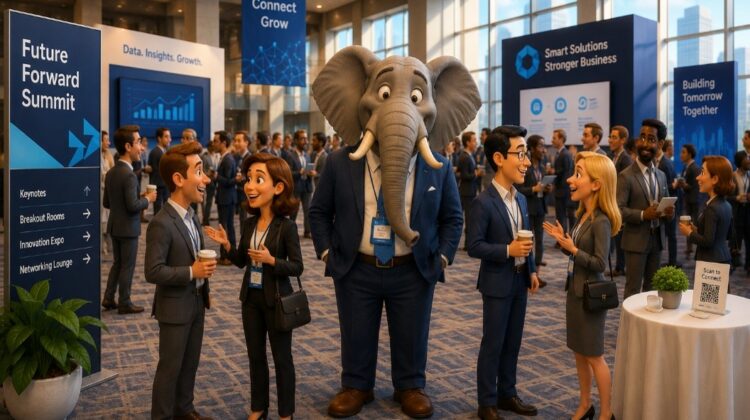
Mark McGready, Director Data Analytics and Solutions for IDEA, attended the 2026 Applied AI for Distributors Conference organized by Distribution Strategy Group. While he spoke to attendees about IDEA’s Data Whispers solution and how Nudge (its avatar) helps drive sales, profits and acts as a virtual sales coach and information resource tailored to each distributor’s offering and is based upon their information, he also observed the “AI frenzy.” He shared his observations about the conference.
2026 Applied AI Conference … A Success
“The Applied AI for Distributors conference from Distribution Strategy Group continues to be one of the best technical and software conferences available to the industry. From June 23rd-25th a capacity crowd gathered in Chicago to discuss the world of AI tools, markets, business dynamics and investment strategies. The format is perfection. The speakers are always relevant and informed, a host of experts sharing detailed, grounded and realistic experiences and predictions about how new AI capabilities can be used for business transformation. There were over 50 software companies in attendance, from long established ERPs to brand new ‘greatest idea’ companies offering software with the paint still wet. Attendees get to take part in a kind of Farmers Market approach, watching from a distance and attending presentation sessions, learning without having to be pitched to, and most would browse around the vendors in a shared ballroom, trying to find one that might be just what they need. The vendors themselves love the conference, as it gets them in front of the right decision makers and champions, and all I spoke to expressed how good the conference had been for them and how many qualified warm leads it had generated. It’s clearly filling a critical need for distributors. I expect it to grow and grow every year.
AI – Juicy Meal or Hockey Puck?
And yet, at the heart of it all, was the unspoken air of uncertainty.

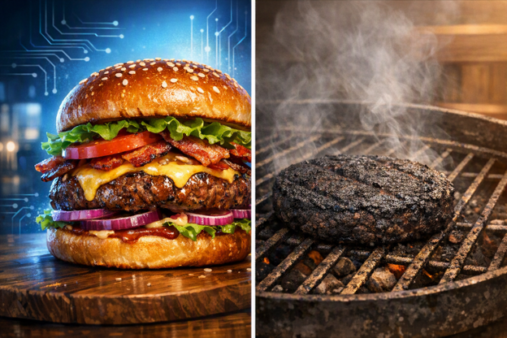
Every vendor gave a compelling pitch, full of logic and promises of significant returns on investment. Every option felt like it would be a no brainer, a guaranteed improvement to daily life back in the office. However, when I asked attendees if they’d seen anything they liked the almost universal response was “I’m not sure”. There’s a hesitation with all this new tech, and I think it’s a hesitation born from experience. This isn’t the first time our industry has been told there’s a new great technology guaranteed to grow sales and profits. And we’ve all learned the hard way that the real life burger never looks as good as the picture on the menu. Artificial Intelligence looks like the best burger you’ve ever had, but it might be that burned hockey puck on the grill Dad considers eating when he’s still hungry after the BBQ.
Is AI Productivity and Revenue Driver or an Elephant to Invest In?
It’s worth taking a step back and looking at the evolution of software in business. With more and more grey hairs appearing every day, I’m now at the point where I begin sentences with “I remember when”, and reflecting on the past puts today in better context . The first major revolution was the personal computer. That combined with the fax machine and later email and Microsoft Office transformed the productivity of the average employee. One person could do the role that three people did previously. Less time was wasted chasing information when it could be delivered to the staff near instantly. Companies saw a huge productivity swing. And because productivity is just process, and process is what makes a business a business, these process improvements led to an economic boom and financial windfall that we’re still nostalgic for.
Then around 2002-2004 or so things began to change. We got new dedicated business software, reporting tools and CRM’s, warehouse management and task specific tools that were promising to continue the productivity gains. The trouble was that productivity gains started to slow, and we’ve had a relatively meek last 20 years. The tools were no longer about processing work, they were simply about organizing work. We didn’t become more productive, we just became busier. These tools were sold on selling more, but few sales people will pin their sales success on the CRM platform they use. Most companies deployed an ecommerce system, but all they got for their trouble was a bunch of small, costly-to-process orders. Warehouses had to be adapted because customers were buying 2-3 products per basket, rather than 20-30. Productivity gains were hard to find.
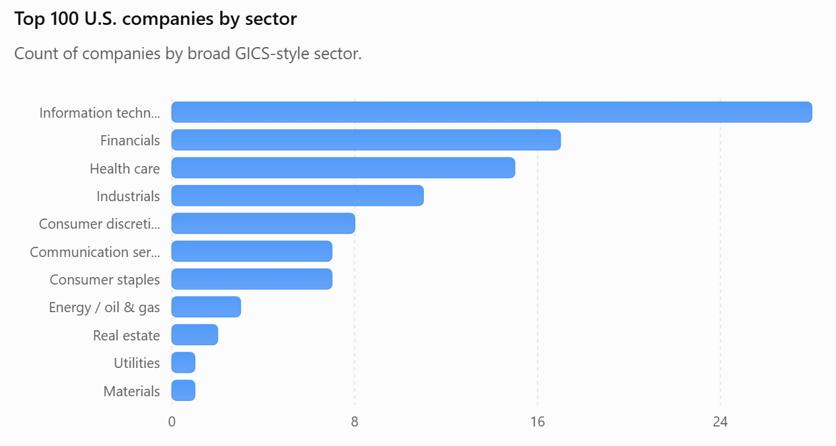
Many staff recognized that these tools were ‘work harder, not smarter’ tools, but the wave of software solves all was a full tsunami, and it’s still going today. The big oil companies got replaced by big software companies. If you look at the top 100 US companies by market cap, 28 are software. Only three are energy.

Yet for the past decade there hasn’t been a transformational software play. Once we got our high speed internet and smart phones we’ve been in mostly a holding pattern. We’ve learned to change the office meeting to the zoom meeting, but the meetings themselves are much the same. Many executives quietly share ghost stories about major software investments almost destroyed their operations. This unease and wariness comes from folks who can still feel the bruises.
In early 2023 ChatGPT launched and the next new thing had arrived. With it came the promises of process efficiency once again. A vision of ‘agents’ able to replace employees. Current AI leaders Anthropic, Open AI (and whatever Elon is up to) value their cash-burning, negative-revenue-having enterprises as being worth trillions. On the planet only 14 companies are worth over a trillion. For the US it’s Nvidia, Apple, Google, Microsoft, Amazon, Broadcom, Meta, Tesla, Micron and good old Walmart. These new AI companies believe they should be somewhere on that list. If ever there was a case of putting the cart before the horse…
There’s only 5 AI companies of significance – Google with Gemini, Meta with Llama, Anthropic with Claude, OpenAI with GPT and Microsoft with Copilot (sorry Grok fans). Even the mighty Apple are mostly sitting on the sidelines of this one, Siri having proven that AI isn’t as easy as it looks. That means every AI vendor is essentially someone building their technology stack on one of these five companies. Google, Meta and Microsoft have all the money in the world to invest in this, OpenAI and Anthropic are burning investor cash like they’re spring breakers, and that bill will come due one day. Something to consider when you think about making AI the core of your enterprise (and something to think about if you ever ask if the Data Center explosion feels like a bubble). What’s the market really going to look like in 10 years? To put it another way, if an AI company is selling you a solution that will replace a $100,000 employee, do you think they’ll settle for charging $199 per year?
There’s another aspect these software companies don’t mention in their presentations. ‘The difference is people’ is not just a line. Distribution is, at it’s heart, logistics. You have similar companies selling the same products to the same customers at the same prices with the same services. Differentiation is in the details, and companies have fought hard to make that differentiation clear in their markets. If everyone becomes the same we’re now the airlines, competing on price and miles programs.
Take order automation for example. It sounds like a perfect application of AI. Receive an order, interpretate it, register the PO and send the acknowledgement. The warehouse gets the ticket 1 minute after the email arrives and it’s on a truck by lunchtime. Seems flawless. And it is, until you take a step back and consider what this means. This is the Instacartification of business. If anyone has used Instacart you’ll know you only buy the things you need, but if you go to the grocery store you spend twice as much on the things you’d forgot you might need. If customers are placing orders without a human on the other end talking the customer through their order, asking what they’re doing with the products, discovering what else they might need, ensuring they’re getting the right products and playing the role of sales support and product expert, then two things happen: you get smaller orders, and you lose your market differentiation. When I hear companies cheer about automated order entry and employee cost savings I think about all the invisible work that employee was doing that the IT team didn’t consider in their plan. When people envision a world of buying agents placing orders with receiving agents I know we’re going to face the same reckoning retailers faced when Amazon digitized the buying experience. Beware the investment that takes away your differentiation.
AI companies are now pivoting from replacing staff to augmenting staff – that alone will limit the price points they might once had hoped for. It’s a smart pivot – if this technology revolution can be akin to the personal computer revolution then we should be celebrating. Perhaps all AI is doing is automating the business organization tasks we’ve introduced over the past 20 years. Probably an essential evolution as we face fundamental labor challenges over the next 20 years.
To be clear I think AI is a good thing, and I think not having AI in your operations would feel like not having computers in your business today. However, for me AI should only be about making your employees more productive – making their role more convenient. And dare I say it, using less software and not more. AI is the chance to fundamentally eliminate software. If I can tell my AI agent to book me a flight, I don’t need the airlines app on my phone anymore. Soon I might not even need a phone anymore, just a key fob and a pair of smart glasses. We don’t need user interfaces if the user interface is just a voice we can talk to. Star Trek leads the way yet again (makes you wonder why everyone had those computer consoles when they could just talk to the starship, but maybe a show about people sitting about talking to themselves wouldn’t work on tv).
Perhaps a world of invisible software is the goal as it gets us back to where we were 40 years ago – building success with great teams, great products and a focus on customer service. Business isn’t that hard, AI doesn’t need to claim that it is.
So, if you’re in the market for some AI after visiting the Farmers Market keep one goal in mind – if you bring this home can it replace two softwares you’re using right now, and will that make your team more productive. Perhaps that reassurance is what’s still missing at these vendor showcases. My hope is that future attendees start saying “I saw something I want to start using immediately” rather than saying “I’m not sure”. Until then at least we have a forum to see what’s on the menu.”
Take Away
- Based upon Mark’s feedback, if you are a distributor with revenues over $50 million, you should consider attending this conference next year. If you are $100+ million, it is a definite “must attend.”
- Given that the HVAC market is contractor-oriented, it is important to consider your AI strategy. Start internally focused and then consider your customers’ buying journey and where there are opportunities. It is much different than an industrially-oriented B2B business sale. Consider how to interact / integrate with contractor project management / procurement / estimating systems. This could become your holy grail to drive a moat within customers that will drive sales and improve productivity.
- Identify ways to improve the sales and informational tools you provide to your sales teams, especially as they “age in place.” This is where / why you should talk to Mark about Data Whispers and how you can hire Nudge to be your virtual sales coach and information resource.




Leave a Reply Cancel reply