

As the HVAC/R industry shifts away from a replacement-driven model and toward service, maintenance, and repair, the implications extend well beyond the contractor. For distributors, this transition is reshaping what customers need most: not just equipment and parts availability, but stronger support around diagnostics, troubleshooting, training (such as the vacuuming testing Don Gillis shared), and application knowledge. In a market where contractors must solve more problems in the field and justify more repairs to end users, distributors have an opportunity to become more valuable partners.
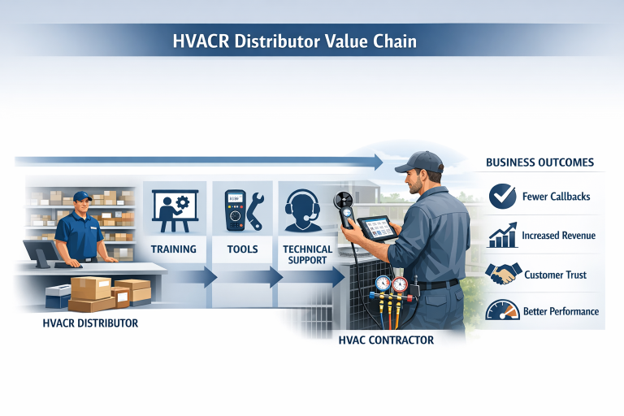
That shift puts a spotlight on a capability that has not always been framed as a distributor issue – diagnostics. As service becomes a larger share of contractor revenue, diagnostic accuracy is increasingly tied to productivity, first-call resolution, customer confidence, and profitability. Distributors that help contractors strengthen those capabilities—through training, tool access, technical support, and better product knowledge—can differentiate themselves in a crowded market while creating new paths for growth.
Bob Allomong from M&M Trades Rep is seeing this firsthand and shared his thoughts and suggestions to help distributors and manufacturer reps, who can provide some of the training for their distributors:
Moving Beyond “Parts Replacement” Mentality
In a replacement-heavy market, technicians could often rely on straightforward workflows: identify a major failure, recommend a new system, and complete the install. In today’s repair-focused landscape, that approach no longer holds up. Customers are more cost-conscious, equipment is more complex, and expectations for transparency are higher.
This means technicians must move beyond a “parts replacement” mindset. Swapping out components based on symptoms rather than confirmed root causes leads to callbacks, eroded margins, and frustrated customers. Instead, technicians need to approach each service call as a diagnostic exercise—one that requires methodical testing, data interpretation, and clear communication.
For business owners, this represents both a challenge and an opportunity. Companies that invest in building true diagnostic expertise will differentiate themselves in a crowded market, while those that don’t risk being stuck in a cycle of inefficiency and inconsistent results.
Electrical Diagnostics: The Foundation Skill
At the core of effective troubleshooting is a strong grasp of electrical systems. A significant percentage of HVAC failures originate from electrical issues, whether in high-voltage components or low-voltage control circuits. Yet many technicians lack confidence in this area, particularly when it comes to interpreting wiring diagrams or diagnosing intermittent faults.
Proficiency with a multimeter is essential, but it’s only the starting point. Technicians must understand how to test circuits under load; trace voltage drops and distinguish between component failure and system-level issues. When a capacitor fails, for example, the real question isn’t just how to replace it—it’s why it failed in the first place. Without that deeper understanding, the same problem is likely to resurface.
Mastering the Refrigeration Cycle
If electrical diagnostics are the foundation, then refrigeration cycle analysis is the heart of HVAC/R troubleshooting. Properly interpreting superheat, subcooling, and pressure-temperature relationships allows technicians to see what is actually happening inside the system.
Too often, technicians rely on rules of thumb or “normal” readings without considering variables like ambient conditions or airflow. In a repair-driven business, that approach is no longer sufficient. Technicians must be able to identify the difference between an overcharged system, an undercharged one, or a system suffering from a restriction—all based on measured data and system context.
Developing this level of understanding requires more than classroom training. It demands repetition, coaching, and a culture that encourages technicians to slow down and think rather than jump to conclusions.
Airflow: The Hidden Factor in System Performance
Airflow is one of the most overlooked aspects of HVAC diagnostics—and one of the most important. A large percentage of comfort complaints and system inefficiencies can be traced back to airflow issues, including duct restrictions, undersized returns, and dirty coils.
Despite this, many technicians still fail to measure static pressure or compare it to manufacturer specifications. Instead, they rely on visual inspections or assumptions, which often miss the root cause of the problem.
For contractors, emphasizing airflow diagnostics can unlock significant opportunities. Not only does it lead to more accurate repairs, but it also opens the door to additional services such as duct modifications and system optimization. In a market where every service call counts, which added value can make a meaningful difference.
Combustion Analysis and Safety
For companies that service gas furnaces and boilers, combustion analysis is a critical diagnostic skill. Beyond performance, it directly impacts safety. Improper combustion can lead to carbon monoxide production, inefficient operation, and long-term equipment damage.
Technicians should be trained to use combustion analyzers and interpret key readings such as oxygen (O₂), carbon monoxide (CO), and carbon dioxide (CO₂) levels. They also need to understand how factors like gas pressure and venting affect combustion quality.
Neglecting this area not only limits service quality but also exposes contractors to significant liability. In a repair-focused business, thorough diagnostics must include both performance and safety considerations.
The Growing Complexity of Controls
Modern HVAC systems are increasingly reliant on advanced controls, including communicating systems, smart thermostats, and integrated home automation platforms. While these technologies offer improved efficiency and user experience, they also add layers of complexity to the diagnostic process.
Technicians must understand sequence of operation, be comfortable navigating control boards and sensors, and know how to troubleshoot communication errors. Logical thinking becomes just as important as mechanical knowledge.
For business owners, this means training can’t remain static. As equipment evolves, so must the skill sets of the technicians servicing it.
Measuring System Performance
One of the defining characteristics of a strong diagnostician is the ability to evaluate system performance beyond whether it simply turns on and off. A system that runs is not necessarily a system that works correctly.
Technicians should be trained to measure temperature splits, calculate delivered capacity, and assess real-world efficiency. These metrics help identify “soft failures”—situations where the system operates but fails to meet performance expectations.
These are often the issues that frustrate customers the most, and they represent valuable opportunities for contractors who can diagnose and resolve them effectively.
Building a Repeatable Diagnostic Process
While technical knowledge is essential, it must be paired with a structured approach to troubleshooting. The best technicians follow a consistent process: gather data, form a hypothesis, test it, and confirm the root cause before making a repair.
Without this discipline, even experienced technicians can fall into the trap of guessing or relying on past experiences that may not apply to the current situation. Over time, which leads to inefficiencies and inconsistent outcomes.
Standardizing a diagnostic process across the organization helps ensure that all technicians, regardless of experience level, approach problems in a systematic way. It also makes training more effective and scalable.
Communication: Turning Diagnosis into Revenue
In a service-driven model, the ability to diagnose a problem is only part of the equation. Technicians must also be able to communicate their findings clearly and convincingly to customers.
This includes explaining what is wrong, why it happened, and what the available options are. Customers are more likely to approve repairs when they understand the issue and trust the person presenting the solution.
Strong communication skills also reduce the likelihood of disputes and increase customer satisfaction. In many cases, they are the difference between a one-time service call and a long-term relationship.
Tools, Technology, and Data
Today’s diagnostic environment is supported by a growing array of tools, from digital manifolds and psychrometers to manufacturer-specific apps and cloud-based platforms. These tools provide valuable data, but they are only as effective as the technician using them.
Training should focus not just on how to use these tools, but on how to interpret the data they provide. Numbers alone don’t solve problems—understanding does.
At the same time, contractors should consider how technology can support consistency across their teams, whether through standardized reporting, shared data, or remote support.
Creating a Culture of Continuous Learning
Finally, it’s important to recognize that diagnostic expertise is not developed overnight. It requires ongoing training, mentorship, and real-world experience. The most successful HVAC/R companies foster a culture where technicians are encouraged to learn, ask questions, and share knowledge.
This might include regular training sessions, ride-alongs with senior technicians, or internal knowledge bases that capture common issues and solutions. Over time, these efforts build a collective intelligence that strengthens the entire organization.
What This Means for Distributors
For distributors, the rise of diagnostic-driven service creates an opening to expand beyond transactional selling and develop tighter, more valued, relationships with their customers … and maybe an additional revenue stream.
Contractors increasingly need help selecting the right instruments, understanding new system technologies, interpreting manufacturer requirements, and building technician confidence in the field. Distributors that can connect products with application support are better positioned to strengthen loyalty and deepen account relationships.
This is also an opportunity to create more strategic value. Training events, tool recommendations, troubleshooting resources, and knowledgeable counter or technical staff can help contractors reduce callbacks, improve first-time fix rates, and make better use of the equipment and parts they buy. In that environment, diagnostics becomes more than a service topic—it becomes a channel advantage for distributors willing to invest in contractor success.
The Bottom Line
As the HVAC/R industry continues its shift toward service, maintenance, and repair, diagnostics is becoming a strategic issue for the entire channel. Contractors who build stronger troubleshooting capabilities will be better positioned to deliver consistent results, while distributors that support those capabilities can create deeper customer relationships and more meaningful differentiation.
The transition will not happen automatically. It requires intentional effort, better training, stronger technical support, and a willingness to rethink how value is delivered across the channel. But for distributors that embrace the shift, the payoff can be significant: stronger contractor loyalty, new opportunities to support service growth, and a more resilient business built on expertise as well as availability.




Leave a Reply Cancel reply