HVAC/R distributors sit in the middle of a demanding value chain: manufacturers rely on them to place products close to the market, while contractors rely on them for availability, technical support, delivery, credit, and problem solving. That middle position creates opportunity, but it also exposes distributors to margin pressure, inventory risk, and rising service expectations.
Customer Stratification Drives Resource Allocation
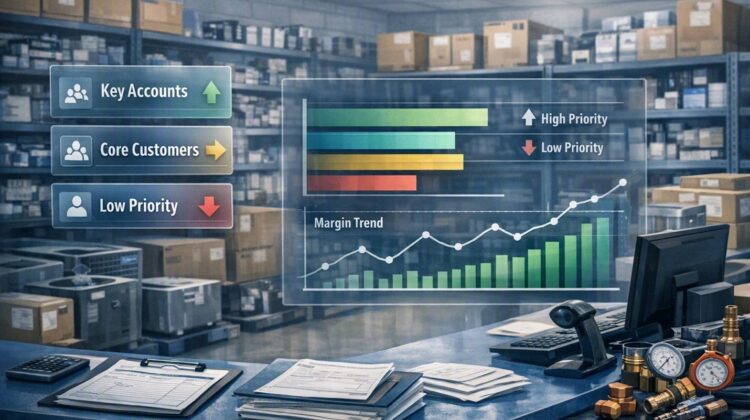
Customer stratification—the practice of ranking customers by buying power, loyalty, profitability, and cost-to-serve—can help an HVAC/R distributor decide where to invest scarce sales, inventory, pricing, and service resources. Rather than treating every contractor account the same, stratification helps the distributor match service levels to economic value and growth potential.
One prevalent issue facing HVAC/R distributors is inventory complexity.
Demand is highly seasonal: cooling products surge in summer, heating products rise in winter, and parts demand can spike when weather changes suddenly. HARDI has noted that HVAC/R companies often struggle with shortages during peak seasons, low inventory turnover, and deadstock accumulation because demand varies by season, region, and product type. These problems tie up working capital and reduce cash flow. At the same time, contractors increasingly expect fast availability of key parts; ACHR News has reported that distribution trends are being shaped by technology, logistics, e-commerce, and contractor expectations for product availability. In this environment, an HVAC/R distributor cannot afford to stock every item heavily for every customer. Stratification helps by identifying which customers justify deeper inventory commitments and which should be served through standard stocking, alternative pickup options, or special-order processes.
A second challenge is margin erosion.
Contractors often negotiate aggressively, request price matches, or expect exceptions based on relationship history. If a distributor’s sales team lacks data on net profit and cost-to-serve, it may over-discount customers that already consume significant resources.
Executives describe this as a common blind spot in HVAC distribution: manual price overrides can quietly reduce gross profit, especially when salespeople do not have clear analytics or pricing discipline. In one example, a multi-location HVAC distributor found that overrides among top salespeople were costing close to $30K in gross profit per salesperson each month … $360K in gross margin annually, per salesperson! after improving visibility and discipline, the distributor reduced overrides by over 20% in a quarter. Customer stratification supports better pricing by separating high-value core accounts from service-drain accounts—customers with high volume but low profitability because they require frequent deliveries, special handling, high credit exposure, or constant price concessions.
A third issue is sales-force productivity.
Outside sales time is expensive, and HVAC/R sales teams often rely on personal judgment or “tribal knowledge” to decide which accounts deserve attention. That can lead to over-serving low-potential accounts while under-developing profitable accounts that could buy more product categories.
The National Association of Wholesaler-Distributors (NAW) recommends a SURGE framework—Segment, Understand, Refine, Generate, and Empower—to group customers into categories such as core, opportunistic, service drain, and marginal.
- Core customers are vital accounts with strong value.
- Opportunistic customers buy when their main supplier is unavailable.
- Service-drain customers buy volume but require costly support.
- Marginal customers buy infrequently while expecting high service levels.
For an HVAC/R distributor this framework can identify which customers should receive proactive outside sales calls, customized training, emergency delivery support, and flexible credit terms, versus those who should be directed toward inside sales, digital ordering, minimum order thresholds, or standardized terms.
Real-world examples show the effectiveness of this approach work.
ACR Supply Company, a North Carolina HVAC/R distributor with 11 locations, used ProSales, a customer stratification software solution to combine ERP data with sales-team knowledge. According to an Earnest & Associates case study, ACR wanted fact-based answers about which customers to focus on and where to invest sales effort.
By implementing a tool aligned with NAW’s stratification methodology, ACR improved customer insight, supported strategies to move marginal customers toward profitability, and increased both top-line revenue generation and contribution margins. This example is especially relevant because ACR operates in HVAC/R distribution, where branch inventory, counter service, parts availability, and contractor relationships are central to the business model.
Customer stratification is also critical for addressing the most challenging and impactful issues distributors face. The areas identified and addressed included:
- over-discounting
- weak cross-selling, and
- poor allocation of sales time due to lack of customer-specific analytics.
Customer stratification creates account-level, actionable analytics that are used to train salespeople on which accounts to focus on and what specifically to discuss with them – resulting in increased gross margin and revenue growth while stabilizing defection of their most precious accounts, their core customers. These finds/scores are not only applied to the outside sales force, but they are also leveraged back into the primary transactional business system (ERP) to aide in establishing pricing and give counter teams and inside salespeople actionable guidance, not just broad sales reports.
For an HVAC/R distributor, the practical benefit of customer stratification is that it converts customer data into operating rules.
- Core customers may receive assigned outside sales coverage, joint business reviews, priority inventory planning, training invitations, and disciplined but competitive pricing.
- Opportunistic customers may be targeted with conversion campaigns when they experience stockouts from competitors.
- Service-drain customers should not automatically be abandoned; instead, the distributor can renegotiate order frequency, delivery fees, freight policies, payment terms, or rebate structures to improve profitability.
- Marginal customers can be profitably served through e-commerce, counter pickup, inside sales, and standard pricing rather than high-touch support.
Customer stratification also improves cross-functional decisions. Sales, purchasing, pricing, and branch operations often view customers differently.
- Sales may see revenue as the measure.
- Purchasing may see slow-moving inventory held.
- Finance may see long payment cycles and cash-flow impacts.
Stratification creates a common fact base: which customers generate net profit, which consume assets, and which have growth potential. In a business facing seasonal demand, product transitions, e-commerce pressure, and consolidation among contractors, that common fact base can protect margins while improving customer experience.
HVAC/R distributors face persistent problems: unpredictable seasonal demand, inventory carrying costs, deadstock, same-day availability expectations, pricing overrides, and limited sales resources. Customer stratification helps by identifying which customers deserve deeper investment, which need a different service model, and which accounts can become more profitable with the right changes. The goal is not to ignore smaller customers, but to serve each segment in a way that matches its value and potential. When applied with discipline, customer stratification can help an HVAC/R distributor grow revenue, defend gross margin, improve inventory productivity, and build stronger contractor relationships.



Leave a Reply