
Two of the leading HVAC manufacturers announced earnings within days of each other that were similar in both results and outlook with strong commercial propelled by data centers but facing cost pressures. Let’s take a look in more detail….
Carrier Global
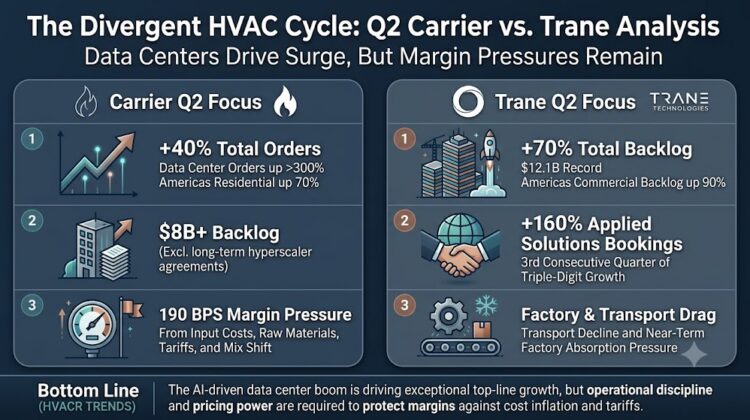
Carrier Global, the Florida headquartered multinational HVACR, fire and security equipment manufacturer, announced earnings for the 2Q 2026 on July 28. Results were better than expected on sales, orders, and cash flow, with North America doing much of the heavy lifting as Commercial HVAC and data center demand stayed exceptionally strong. Organic sales increased 3% to $6.351 billion, however adjusted operating margin decreased 190 basis points, pressured by increased costs for raw materials and components, including the impact of tariffs, and a shift to lower-margin products. This shows the tension that now defines U.S. HVAC manufacturing – solid demand on one side, and tariffs, input-cost inflation, mix pressure, and portfolio exits on the other.
Carrier’s total company orders rose about 40%, led by Commercial HVAC up roughly 65% and data centers up more than 300%, which is a major signal for the U.S. market. Orders in Americas increased 65%, with residential orders up 70%, light commercial up 25% and commercial orders up 100%. That matters because Carrier is a bellwether for the North American HVAC cycle, and its results suggest that cooling demand tied to construction, electrification, and digital infrastructure remains healthy. Residential weakness remains as residential orders were down 60% year‑over‑year due to a late summer start, even though overall residential sales were up 9%
Carrier reported four segments, Climate Solutions (CS):
- CSA – Americas: Sales were $3.37 billion, up 4%, with organic growth also 4%; Residential rose 9%, Light Commercial 10%, while Commercial fell 8% because customer delivery timing shifted. Segment operating profit was $823 million, down 6%, and margin fell to 24.4% from 27.0%, mainly because price gains were more than offset by unfavorable mix and higher input costs.
- CSE – Europe: Sales were $1.32 billion, up 6%, with organic growth 3%; Residential was up high single digits, while Commercial was down mid-single digits.
- CSAME – Asia, Pacific, Middle East, and Africa: Sales rose 4% to $917 million, driven by double-digit growth in India, the Middle East, Southeast Asia, and Australia, but China remained pressured in light commercial.
- CST – Transportation: Sales rose 2% to $738 million, with strong container growth offsetting weaker global truck and trailer.
For the first half, CSA still dominated the profit picture, but margins across the portfolio were down, showing that growth alone is not fully translating into earnings leverage yet.
In the quarter, Carrier’s data center business grew fourfold, contributing to total company orders up ~40%. Total company backlog (excluding long‑term hyperscaler/colo agreements) exceeded $8 billion, up ~40% YoY and ~20% sequentially.
Analyst Concerns
Concerns of shareholders include softer residential HVAC volume weakness, which tempered overall growth despite strong commercial HVAC sales. This softness in volumes raised concerns among investors and affected sentiment despite the strong earnings.
Backlog concerns are a tale of two cities there is backlog strength in Commercial Segments as Carrier ended Q2 with a robust and growing longer-cycle backlog in the commercial HVAC and related longer-cycle businesses, setting them well for a strong 2H. This backlog provides a cushion for revenue stability and future growth despite soft near-term orders in some segments.
Tariffs and Inflation Weigh
Tariffs and inflation remain central risks for Carrier because they affect component costs, sourcing strategy, and ultimately pricing power in the U.S. HVAC market. Earnings explicitly stated that adjusted margin was reduced by increased input costs and unfavorable mix, and management flagged tariff uncertainty in its forward-looking risk disclosure. In practical terms, this means Carrier is still able to pass through some pricing, but not enough to fully offset cost inflation and mix drag every quarter.
The company also highlighted new U.S. factory costs in its guidance, which suggests it is investing to localize production and strengthen supply chains. That may help over time, but it can pressure near-term margins before productivity and scale improvements show up.
Guidance and Concerns
Carrier raised its full-year outlook to about $23 billion in sales, about 4.5% increase based on stronger‑than‑expected first‑half results, record backlog levels, and robust demand in data centers and commercial HVAC. Management increased its 2026 data center sales forecast to ~$2 billion, with $1.5 billion expected in the second half. The company also said the outlook includes about a $0.05 EPS hit from the NORESCO exit and new U.S. factory costs. That upgrade matters because it signals confidence in backlog, commercial HVAC momentum, and data center demand, even as management still has to absorb portfolio restructuring and plant-related costs. Management also warned that Q3 operating margin is expected to fall sequentially to about 16.5%, indicating ongoing pressure.
Another issue was concerns of the durability of the data center boom. Management’s response, reflected in the release, was that data center demand remains a major order driver globally and that record backlog gives them confidence in the outlook. Analysts also probed how much of the North American strength was timing versus true end-demand, and the company’s answer appears to be that residential and light commercial are improving while commercial remains supported by large project activity and data center spending.
Carrier’s Q2 – What it means for US HVAC Market
Carrier’s quarter says the U.S. HVAC industry still has solid underlying demand, especially from data centers, commercial buildings, and improving light commercial/residential channels. It also shows that the industry is in a more difficult phase on the cost side, where tariffs, input inflation, and mix issues can erode margins even when volumes are good.
For the broader U.S. HVAC manufacturing sector, the message is that growth is still there, but the winners will be the companies that can localize production, manage pricing carefully, and maintain exposure to high-growth end markets like data centers. Carrier’s results suggest the market is not weak, but it is demanding more operational discipline than it did a year ago.
Trane – Record Backlog and Bookings Surge, Commercial HVAC Boom Trumps Residential Softness
Trane Technologies announced earnings for 2Q 2026 on July 30. Trane delivered another standout quarter, with revenue up 11% to $6.35 billion, and a record backlog of $12.1 billion (up 70% y-o-y) driven by unprecedented demand in Americas Commercial HVAC, particularly data centers and applied solutions.
Trane operates through three primary business segments, which showed dramatically different performance in Q2 2026:
- Americas Commercial HVAC revenue increased 12% to $5.27 billion, up 11% organically, with Commercial HVAC revenues growing in the low teens. Backlog increased 90%, accounting for more than 90% of the total enterprise backlog and in the Americas, and Applied Solutions bookings surged over 160% in Q1 2026, marking the third consecutive quarter of triple-digit growth as customers secure long-term capacity through master purchase agreements. Bookings increased 50% organically, with applied equipment orders up 130%.
- Americas Residential HVAC revenue increased in the low teens, an improvement from prior quarters. The company raised its 2026 residential revenue outlook to mid-single-digit growth following strong first-half performance and healthy channel inventories (a different outlook than provided by Lennox) as channel inventories have normalized, with no further destocking expected, providing a stable foundation for future growth.
- Transport Refrigeration revenue declined by low double digits, as expected, reflecting ongoing cyclical softness in the transport market. Transport market fundamentals suggest a trough in the first half of 2026, with management projecting a gradual recovery starting late in the year and strengthening into 2027.
Management attributed the quarter’s strong performance to several key factors:
- Americas Commercial HVAC strength, the primary growth engine, featured strong revenue and bookings.
- The company saw unprecedented demand for data center cooling solutions, with Applied Solutions bookings in the Americas surging and continuing strong momentum in Q2. Data center orders are up more than 300% across the industry, reflecting the AI-driven construction boom.
- Trane achieved positive price realization, which helped offset rising input costs and continued high levels of business reinvestment.
- Services revenue, now representing approximately one-third of total enterprise revenue, continues to grow at a low-teens CAGR, providing a durable and high-margin recurring revenue stream.
- The acquisition of Stellar Energy strategically expanded the portfolio into modular data center cooling, addressing skilled labor scarcity through off-site manufacturing.
However, the company faced headwinds in certain areas, including Transport Refrigeration where revenues declined, as expected, reflecting ongoing cyclical softness in the transport market. Management noted a shift in the residential manufacturing playbook toward “level loading” factories, which creates near-term absorption pressure but improves long-term operational efficiency. Higher commercial volumes and positive price realization helped the company offset rising input costs and continued high levels of business reinvestment.
Analyst Concerns
Analysts expressed concerns about the sustainability of data center demand. Management expressed strong confidence in the sustainability of data center demand, citing the multi-year AI infrastructure buildout and the company’s strategic acquisition of Stellar Energy to expand its modular data center cooling portfolio. Applied Solutions bookings have surged over 160% for three consecutive quarters, indicating sustained customer commitment through master purchase agreements.
Residential recovery also weighed, to which management replied that channel inventories are now normalized, with no further destocking expected and raised its 2026 residential revenue outlook, assuming a pivot to growth in the second half aided by easier prior-year comparisons and stable channel inventory.
While Trane did not provide extensive commentary on tariffs and inflation during the Q2 2026 call, management addressed several relevant points noting that higher commercial volumes and positive price realization helped offset rising input costs and continued high levels of business reinvestment. Management also indicated that the company achieved positive price realization, demonstrating its ability to pass through cost increases to customers while maintaining volume growth.
Guidance
Trane raised its full-year 2026 guidance, reflecting increased confidence in the commercial HVAC boom and strong order momentum. The revenue outlook was increased from 8.5% to 9.5% range to 11.5%, and organic revenue growth also revised upwards to 9%. The company raised its 2026 residential revenue outlook to mid-single-digit growth following strong first-half performance and healthy channel inventories (in contrast to Lennox’s outlook, suggesting that the residential recovery is uneven).
Trane’s Q2 – Insights into the US HVAC Market
Trane Technologies’ Q2 2026 results are critically important for understanding the broader HVAC market dynamics in the United States. As the leader in commercial HVAC, particularly in applied solutions and data center cooling, Trane’s performance provides an insights on the health of the commercial HVAC market. The company’s 50% organic bookings growth in Americas Commercial HVAC and 130% surge in applied equipment orders indicate unprecedented demand in commercial end markets, particularly data centers driven by the AI infrastructure boom.
This commercial strength is a stark contrast to the residential market’s ongoing challenges, highlighting the divergence between these two segments and suggesting that companies with greater commercial exposure are better positioned to navigate the current environment.
Trane’s record backlog and exceptional applied solutions performance underscore the transformative impact of the AI-driven data center construction boom on the HVAC industry. The company’s strategic acquisition of Stellar Energy to expand its modular data center cooling portfolio positions it to capture a significant share of this high-growth market.
For the broader HVAC distribution market, this suggests that data center and large-scale commercial projects are becoming an increasingly important growth driver, potentially offsetting weakness in traditional residential and commercial segments.
Trane’s record backlog provides exceptional visibility into future growth and highlights a trend in the commercial HVAC market – customers are proactively ordering 12 to 18 months in advance to secure supply chain certainty. This shift in customer behavior reflects ongoing supply chain concerns and the competitive dynamics of the data center and large-scale commercial markets.
Finally, Trane’s Q2 2026 results underscore the importance of strategic positioning for the next upcycle. The company’s heavy commercial exposure (particularly in data centers) has been a significant advantage during the residential downturn. Services revenue provides a durable and high-margin recurring revenue stream, cushioning the company against cyclical volatility. The Stellar Energy acquisition and continued investment in innovation demonstrate the company’s commitment to capturing growth in high-value segments and staying ahead of market trends.


Leave a Reply