Lennox, a leading provider of climate control products specializing in HVAC solutions for residential and commercial market, announced 2Q 2026 earnings on July 29.
Lennox’s results highlighted a stark divergence between its resilient commercial business and a persistently weak residential market, with revenue up 3% to $1.5 billion, missing expectations, and segment margin contracted 30 basis points to 23.0%, as the company slashed full-year guidance, sending shares tumbling nearly 20% to multi-month lows. The HVAC manufacturer’s performance underscored ongoing challenges in the U.S. housing market while demonstrating the strength of its commercial and emergency replacement initiatives, with management now expecting the most meaningful residential recovery to extend into 2027 rather than materializing in the second half of 2026.
Lennox operates through two primary business segments, which showed the dramatically different performance:
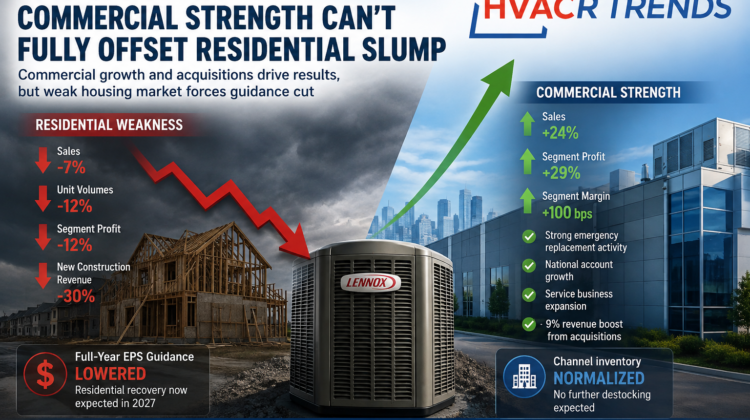
- Home Comfort Solutions (Residential), about 60% of revenue, had sales of $936 million, down 7% year over year, with segment profit $222 million, down 12% and segment margin of 23.7%, down 130 bps.
The residential segment faced significant headwinds, driven primarily by a 12% drop in unit volumes. Within this segment, one-step distribution channels (direct to dealers) saw approximately 12% volume declines, while two-step channels (through distributors) declined roughly 2%. The residential new construction market was particularly weak, with revenues down approximately 30% during the quarter as the company made deliberate decisions to walk away from low-margin business in an aggressively competitive pricing environment.
- Building Climate Solutions (Commercial), about 40% of revenue, had sales of $610 million, up 24% year over year, with segment profit $155 million, up 29% and segment margin of 5%, up 100 bps.
The commercial segments performance was driven by strong execution with national account customers, healthy emergency replacement activity, and growth in service offerings. Acquisitions added 9% to revenue growth in this segment.
Management noted that there is a significant amount of market share gain in the commercial segment, supported by the company’s new factory and focus on emergency replacement, with the market also showing signs of improvement after a long period of decline.
Management attributed the quarter’s performance to several additional and offsetting factors including acquisitions. Duro Dyne, Supco, and the recently announced Comfort-Aire, Century, and Coast Air brands, contributed approximately 4-5% to revenue growth and $17 million to segment profit.
The company’s deliberate decision to walk away from low-margin new construction business, while investing in distribution network efficiencies and sales capabilities in replacement markets, suggests a strategic shift toward profitability over volume in certain segments.
This approach may signal a broader industry trend toward more disciplined pricing and margin management, particularly in the new construction segment where competitive pressures have been intense. For distributors and contractors, this suggests that the competitive landscape may be evolving, with manufacturers increasingly focused on higher-margin business and long-term customer relationships.
Inventory Normalization and Channel Health
Management’s confirmation that channel inventory is now normalized and that no further destocking is expected removes a significant uncertainty that has weighed on the industry for several quarters. This provides a more stable foundation for future growth and suggests that the worst of the inventory correction is behind the industry.
For distributors and contractors, this indicates that order patterns should become more predictable and aligned with underlying demand, reducing the volatility that has characterized recent quarters. However, the normalization of inventory also means that future growth will need to be driven by genuine demand recovery rather than inventory replenishment, placing a premium on understanding and responding to end-market trends.
Lennox’ Guidance
In response to the persistent residential weakness, Lennox lowered its full-year 2026 adjusted EPS guidance, while reaffirming revenue growth guidance at approximately 8% (now including a 5% benefit from completed acquisitions, up from 4% previously). Driving the revision, Lennox expects residential to be down high single digits for the full year, reflecting the continued weakness in new construction and the company’s decision to walk away from low-margin business.
Management reset expectations for residential, now expecting the most meaningful recovery benefits to extend into 2027 rather than occur in the back half of 2026 as previously anticipated. Continued market share gains in emergency replacement and national accounts are expected to offset residential softness, with commercial revenue expected to remain strong throughout the year.
Analyst Concerns About Lennox
Residential market weakness was the primary concern and management responded that the majority of the decline was due to residential new construction, where the company walked away from low-margin business. This impact is felt more in Q2 due to seasonality. While underlying sell-through remains weak, it is improving, and the company expects improvement as it laps some of the residential low-margin loss in the second half and comps get easier. However, residential volumes are now expected to be down high single digits for the full year. The inflation expectation remains at 5%, with benefits from the Section 232 tariff adjustments offset by ongoing inflation in commodities, fuel, and other areas.
Concerns about margin weakness in 2H were a concern, with management responding that this is to fixed cost absorption on lower volumes, and that they expect the margin headwind in 2H to be better than 1H, driven by volume growth and improved pricing initiatives. The underlying mix is positive due to walking away from low-margin accounts, although this is masked by other factors like absorption.
Management indicated there is a significant amount of share gain to be had in commercial, supported by the company’s new factory and focus on emergency replacement. The market is also showing signs of improvement after a long period of decline. A large portion of the improvement is due to share gain, with some benefit from the market not declining anymore.
Bellwether for Residential HVAC Demand
As one of the largest HVAC manufacturers in North America, Lennox’s performance provides a crucial read on the health of the residential HVAC market, which is heavily dependent on housing activity and consumer spending. The company’s 12% decline in residential unit volumes and 30% drop in new construction revenues highlight the persistent challenges facing the housing market, including elevated mortgage rates, inflationary pressures, and historically low consumer confidence.
Lennox’s results confirm that the residential HVAC market remains under significant pressure, with the recovery taking longer to materialize than many industry participants had anticipated. The company’s reset of expectations, pushing the most meaningful recovery into 2027, suggests that distributors, contractors, and investors should temper their near-term optimism about a rapid residential market rebound.
Commercial HVAC Market Resilience
In stark contrast to the residential segment, Lennox’s Building Climate Solutions business demonstrated the resilience and growth potential of the commercial HVAC market. The revenue growth and performance in emergency replacement and national accounts indicate that commercial end markets are stabilizing and, in some cases, growing.
This divergence between residential and commercial markets is a critical insight for industry participants, suggesting that companies with greater exposure to commercial and light commercial segments may be better positioned to navigate the current environment (Carrier and Trane). Lennox’s success in emergency replacement, in particular, highlights the importance of service-oriented business models and the value of quick-response capabilities in the commercial HVAC market.
Lennox’s continued investment in acquisitions (Duro Dyne, Supco, Comfort-Aire, Century, Coast Air) and its focus on emergency replacement and service offerings highlight the strategic importance of diversification and vertical integration in the HVAC industry. This suggests that the industry is consolidating and that companies with the scale and resources to pursue strategic M&A may be better positioned for long-term growth.
In sum, Lennox’s Q2 2026 results paint a picture of an HVAC market in transition, with residential challenges persisting longer than expected but commercial strength and strategic initiatives providing a path forward. For industry participants, the key takeaway is that while the near-term residential recovery may be delayed, the long-term fundamentals of the HVAC market remain intact, and companies that can navigate the current environment while investing for future growth will be well-positioned when the market turns.
Primary Keyword: HVAC market
Secondary/Long-Tail Keywords: residential HVAC volume decline, commercial HVAC emergency replacement, Lennox channel inventory normalization, HVAC manufacturers new construction strategy


Leave a Reply