

An HVAC contractor can have excellent technicians and still lose time because the product information behind a job is incomplete, stale or trapped in separate systems. A model number may identify the equipment but not the matched system. A distributor portal may show today’s price and availability, while the contractor’s estimate still carries values copied weeks earlier. Installation instructions, warranty documents and replacement guidance may live in still other places.
How Better HVAC Product Data Improves Information Flow to Technicians
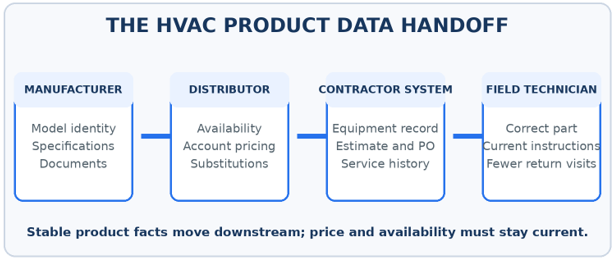
The answer is not to copy every piece of distributor data into field service software. Contractors need a deliberate data handoff: stable product facts should move into the systems used for estimating and service, while volatile information such as price and availability should be refreshed at the point of decision.
Start by separating product facts from commercial data
Product data is not one category. The distinction matters because each type has a different owner and refresh cycle. Manufacturer-controlled facts include the manufacturer name, model and part number, description, dimensions, electrical characteristics, refrigerant, efficiency ratings, compatible accessories, replacement relationships, installation literature and warranty terms. These fields should remain tied to a durable identifier and should not be casually rewritten by each downstream system.
Certified performance data can be checked through the AHRI Directory of Certified Product Performance. ENERGY STAR also publishes searchable product information and downloadable datasets for eligible equipment. Those sources are useful for validation, but they do not replace the distributor’s commercial information or the contractor’s own equipment history.
Commercial data changes more frequently. It includes branch availability, lead time, account-specific pricing, quantity breaks, freight, local substitutions and order status. Contractors should treat a price stored in an estimate as a dated snapshot, not a permanent product attribute.
Ask distributors for data that can be used, not just viewed
A portal is helpful for a single lookup. It is less useful when an office must prepare many estimates, update a price book or give a technician reliable information without retyping it. Contractors should ask preferred distributors what structured options they support: a catalog export, scheduled file, API, electronic data interchange connection or integration through the contractor’s purchasing or field service platform.
At minimum, the exchange should include a durable distributor item number, manufacturer and manufacturer part number, clear description, unit of measure, product category, replacement or supersession status, branch or warehouse availability, account price, price effective date and links to current technical documents. If kits or matched systems are involved, the relationship among components should be explicit.
Preserve identity through the contractor workflow
The most important control is a consistent identity. Free-text descriptions such as “three-ton heat pump” are not enough. The estimate, purchase order, work order and equipment record should carry the same manufacturer and distributor identifiers. That continuity lets the office confirm what was quoted, the buyer order the intended item and the technician see what belongs at the customer site.
A contractor does not need to expose every purchasing field to every employee. The field view should emphasize what the technician needs: the exact item, compatible equipment, current instructions, required accessories and any approved substitute. The office may also need pricing history, supplier, purchasing status and margin. One underlying record can support both views.
Create a refresh rule for information that expires
Every imported field should have an owner and a refresh rule. Product dimensions may change only when the manufacturer revises the record. Availability can change by the hour. Pricing may be valid for a contract period, a branch or a specific quote. Contractors should store the source and last-updated date, then define when the system must recheck the distributor before an estimate is approved or a purchase is released.
This approach also makes substitutions safer. A distributor’s suggested replacement should not silently overwrite the original model. The contractor should preserve the requested item, record the proposed substitute and require a review of compatibility, capacity, electrical requirements, warranty and customer approval when applicable.
The best handoff reduces decisions made from memory
Quality HVAC product data does not come from a single universal source. It is assembled from manufacturer records, certified performance directories, distributor commercial systems and the contractor’s own service history. The contractor’s job is to define which source is authoritative for each field and keep the identifiers intact as information moves downstream.
When that handoff works, estimators spend less time searching, purchasing teams place fewer corrective calls and technicians arrive with clearer information. The goal is not a larger catalog. It is a smaller number of avoidable decisions made from memory. Contractors evaluating their own process can begin by tracing one common equipment replacement from the distributor’s system into the estimate, purchase order, scheduled job and final equipment record. The gaps will become obvious. For an example of how those records can be organized within a field service workflow, see Bella FSM’s HVAC software overview.


Leave a Reply