
TL;DR: Independent HVAC distributors should judge consolidation by one test: will a buyer strengthen or weaken customer intimacy? Mapping the value chain, identifying services customers need, and testing a buyer’s record, local decision rights, and investment commitments can reveal whether a deal preserves trust and creates mutual value—or destroys it.
Watsco’s agreement to acquire The Granite Group, announced in September, as well as QXO’s and Home Depot’s recent moves (especially Home Depot acquiring Mingledorff’s and Lohmiller & Company through SRS) has raised the question for many independent distributors whether they can or should avoid being consolidated. But before asking that question, smaller, regional, independent distributors must ask, “Who am I? Why am I here?”
Why Not More HVAC Distributor Consolidation?
In industrial distribution, standard economic theory would predict far more consolidation than has happened to date. Large, national platforms have the resources to optimize warehouse operations and logistics. They also hold much stronger bargaining power with suppliers, which lowers costs. Economies of scale should favor them. Yet the long tail of smaller, regional, local distributors persists. Why?
Why Independent HVAC Distributors Continue to Succeed?
The answer lies in those two questions. Independent distributors continue to succeed because of they focus on customer intimacy. They know their customers both as businesses and as people. They know their markets. They have consistently come through for their customers in the toughest situations. No corporate policy stops the local branch or salesperson from going above and beyond for a customer. They have earned trust.
The largest acquirers appear to understand this. Watsco said The Granite Group will continue to operate as an independent business under its existing management team. SRS said Lohmiller’s owners will continue to lead that company.
Therefore, when you weigh the consolidation question, ask whether joining a larger platform will strengthen or erode customer intimacy. Some national platforms have bought regional independents, forced standard policies and programs on them, anger customers, and lost business. Conversely, when a buyer invests in capabilities which enhance customer intimacy, consolidation can benefit the seller, the buyer, and the customer.
The Independent Difference – Customer Intimacy
Independent distributors know their customers’ businesses in depth, which positions them to partner with customers and create new, mutually beneficial value. Customers now ask distributors for services such as procurement, kitting, prefabrication, jobsite or on-location inventory management, and technical support. Work closely with customers to learn which services would best help their business processes, create efficiencies, and remove bottlenecks. That work will reveal the capabilities and investments needed to deepend customer intimacy. With this knowledge and a plan, you can show potential acquirers what needs to be done and test whether they can and will provide the resources needed to achieve your plan.
Start this evaluation with the value chain. Map who performs each value-added activity today. The map will reveal where you could expand and where you could perform an activity more effectively than the incumbent. Figure 1 shows an example.
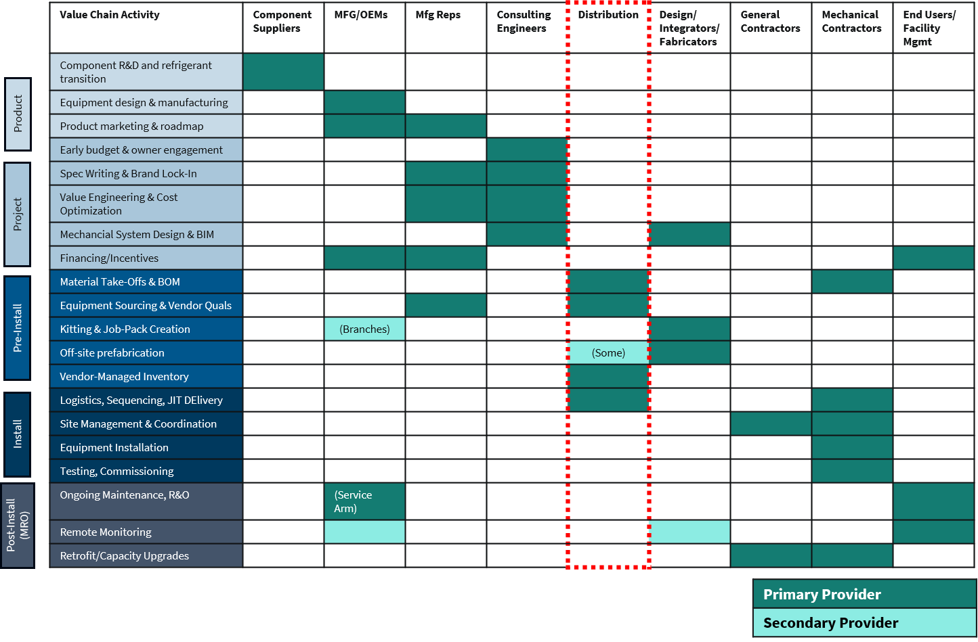
Figure 1: Value chain map of activities and entities involved in delivering an HVAC/R system for a typical construction project. The dotted outline marks the activities distributors perform today.
Source: Ducker Carlisle analysis, company websites, market research interviews, FMI, Dodge, U.S. Census Bureau
In this example, distributors typically provide material takeoffs, equipment sourcing and vendor qualifications, vendor managed inventory, and logistics, sequencing, and just-in-time delivery. But could distributors provide more value than the current provider elsewhere in the chain? For example, could they take on kitting or job-pack creation and do it better than integrators or fabricators? Would that shorten construction and installation timelines, reduce jobsite labor and scheduling issues, and help customers finish projects faster, decreasing time to revenue and improving margins? A value chain review produces hypotheses you can test with customers. Testing them together builds customer intimacy and helps address the productivity problem in construction and manufacturing.
Questions HVAC Distributors Should Ask An Acquirer
Before you sign, ask any potential buyer three questions:
- How did customer retention and branch-level service change at the distributors you acquired in the past?
- Which decisions will stay with local branches, and which will move to headquarters?
- Which capabilities in our plan will you fund, and on what timeline?
As consolidation accelerates, remember who you are and why you are here. Customer intimacy is your major advantage. Whether you stand alone or sell, maintaining and enhancing this customer intimacy will ensure your success. If a consolidator historically has bought distributors, standardized them, and damaged customer intimacy, avoid them. If they have provided capabilities and investments to enhance customer intimacy, the partnership can work for everyone.
About the author
Kevin Sarb, Principal, Industrials Practice
Kevin Sarb is a Principal at Ducker Carlisle, leading the Industrials Practice with a focus on energy, climate technologies, and commercial excellence. He brings 20 years of management consulting experience helping industrial clients develop growth strategies and build commercial capabilities that deliver measurable results. Kevin holds degrees from the University of Notre Dame, the University of Michigan, and the University of Chicago Booth School of Business.
Contact: ksarb@duckercarlisle.com | duckercarlisle.com


Leave a Reply