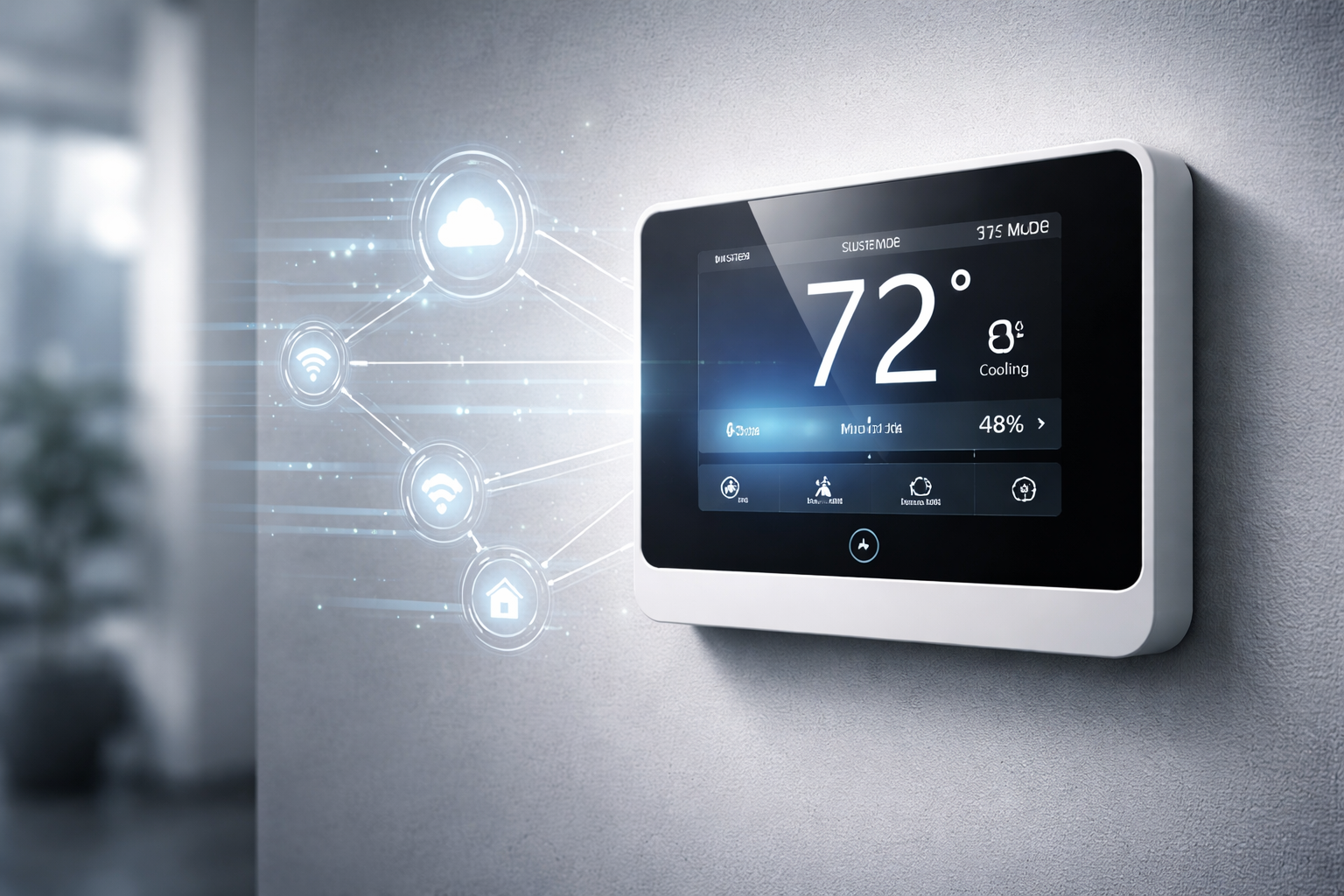
The HVAC/R industry crossed a line without much debate. Smart HVAC privacy wasn’t on the agenda when connected thermostats and cloud-based controllers became standard. The focus was efficiency, remote access, and fewer callbacks. But modern systems don’t just control temperature. They collect data. Occupancy patterns, schedules, runtime behavior, user access logs. The equipment we sell now knows things about the people who use it. And the supply chain hasn’t had an honest conversation about what that means for customers, contractors, or the channel itself.
Why the HVAC/R Supply Chain Can’t Dodge the Privacy Question Anymore.
By Bob Allomong
The HVAC/R industry prides itself on being practical. We move air, control temperature, and solve physical problems. We’re not supposed to chase hype. Yet, without much debate, the industry crossed a quiet line: we stopped selling equipment and started selling data systems.
Connected thermostats, cloud-based controllers, occupancy sensors, and AI-driven optimization are now standard. They promise efficiency, fewer callbacks, better comfort, and lower emissions—and often deliver. But modern HVAC/R systems are also embedded data collectors. And the industry, especially the supply chain, hasn’t had an honest conversation about what that means.
Smart HVAC/R Knows More Than We Admit.
Today’s systems track far more than temperature. They monitor occupancy, movement patterns, schedules, runtime behavior, air quality, user access logs, and performance tied to specific locations. Add mobile apps and cloud dashboards, and a comfort system becomes a behavioral record.
In homes, that data can reveal when occupants wake up, leave, or travel. In commercial buildings, it can expose staffing levels, work habits, and space utilization. This isn’t hypothetical—the data already exists. What’s missing is transparency around how it’s used, who controls it, and who’s accountable when things go wrong.
Convenience Is the Industry’s Favorite Distraction.
Smart HVAC/R didn’t succeed because customers wanted to be monitored. It succeeded because it’s convenient. Remote access reduces service calls. Demand-response programs unlock rebates. Predictive maintenance sounds transformative. Contractors win. Manufacturers win. Utilities win. Everyone wins.
Convenience also eliminates scrutiny. Terms of service go unread. Cloud accounts get created just to make systems function. Contractors commission platforms without explaining long-term implications. No one asks what happens to the data after installation. By the time questions surface, the system is live—and control already sits elsewhere.
The Wholesaler Problem Nobody Talks About.
This is where wholesalers get pulled in, whether they want to be or not. From their perspective, smart HVAC/R products are no longer just hardware. They’re physical gateways into software platforms wholesalers don’t own, don’t control, and often don’t fully understand.
Many “smart” components:
- Require cloud connectivity to work as advertised
- Depend on ongoing subscriptions
- Lose features when licenses lapse
- Become partially useless if platforms are discontinued
That’s a radical shift from traditional HVAC/R equipment—and it creates new risk. When systems lock users out, lose functionality, or expose data, the first call doesn’t go to a cloud provider’s legal team. It goes to the contractor, then the supply house. Wholesalers didn’t sign up to mediate privacy disputes, but smart HVAC privacy is now part of what they sell whether they like it or not.
Data Ownership: Ask the Question, Get a Mess.
Ask who owns smart HVAC/R data and the answers get uncomfortable fast. Manufacturers claim rights to “aggregated or anonymized data.” Software partners analyze usage “to improve services.” Utilities access systems through incentive programs. Contractors sometimes retain admin credentials long after commissioning. Building owners assume the data belongs to them—until they learn otherwise.
Wholesalers sit in the middle. They didn’t write the license agreements. They don’t host servers. Yet they’re expected to explain why a customer can’t fully control a system they paid for. That’s not a technical issue. It’s a trust issue, and it’s why smart HVAC privacy can’t stay off the agenda.
When Optimization Starts Looking Like Surveillance.
In commercial buildings, the privacy problem sharpens. Occupancy sensors installed for airflow optimization double as people counters. AI systems adjusting ventilation based on “activity levels” can quietly reveal employee behavior patterns.
Is this how systems are marketed? No. Is it how the data can be used? Absolutely. Once data exists, someone will find value in it. When that happens, the line between efficiency and surveillance blurs fast. HVAC/R doesn’t get to pretend it isn’t part of that equation.
The Fallout When Privacy Goes Wrong.
When data access and accountability aren’t clearly defined, the damage becomes real. It shows up at job sites and supply counters.
- Wholesalers become the blame point.
- Contractors lose credibility.
- Customers feel misled when they discover they don’t control their own systems.
“Smart” stops sounding innovative once the fine print becomes visible.
Cybersecurity incidents become HVAC/R problems. A hacked controller isn’t abstract when it shuts down a building or becomes a back door into a corporate network. Ten years ago, no one worried about hacked thermostats. Today, it’s a realistic breach vector.
Wholesalers now sell products with cybersecurity risk but often receive vague assurances instead of real answers about encryption, patching, and third-party access. “We take security seriously” isn’t a policy—it’s marketing. And disclaimers don’t rebuild trust after failure.
Data Power and the Channel Squeeze.
There’s another uncomfortable reality: smart HVAC/R platforms allow manufacturers to monitor installed equipment, push updates, sell analytics, and build direct relationships with end users—often without distributors or contractors in the loop.
Data enables that shift. For wholesalers, the question is unavoidable: Are we stocking products that train the market to bypass us? When manufacturers own the software, the data, and the customer relationship, distribution risks becoming logistics instead of partnership.
Neutrality Is No Longer an Option.
The HVAC/R supply chain prefers neutrality. That works when products are simple. Smart HVAC/R isn’t simple anymore.
Wholesalers are trusted advisors whether they want to be or not. Contractors listen to them. Customers trust them. Silence on privacy increasingly looks like complicity. The wholesalers who stay relevant will push manufacturers for transparency, educate contractors on access and ownership, and treat privacy as part of product quality—not an afterthought.
Convenience or Creepy? The Industry Must Choose.
Smart HVAC/R delivers real value. No one is arguing against efficiency, comfort, or innovation. But when technology moves faster than accountability, trust erodes. And once trust is gone, efficiency doesn’t matter.
In an industry built on relationships and service, privacy is no longer a side issue. It’s a business issue. Comfort shouldn’t come with hidden strings. And the HVAC/R supply chain can’t pretend it isn’t part of the “privacy” debate anymore.
Welcome to the future.
About the Author
Bob Allomong is an independent manufacturers’ representative with M&M Trades Rep, serving Colorado, New Mexico, El Paso, and West Texas. He has 38 years of experience across wholesale distribution and manufacturer representation, including counter sales, outside sales, and director-level roles on the manufacturing side. That range gives him a full-circle view of what drives growth across the skilled trades channel.
Closing Thoughts:
Bob is pointing at something the channel has been slow to name. Smart systems changed what HVAC/R equipment actually is, but the conversations around trust, ownership, and accountability haven’t caught up. Wholesalers and contractors are fielding questions they didn’t expect to answer. Manufacturers are collecting data they haven’t fully explained. And customers are learning the hard way that smart HVAC privacy wasn’t part of the sales pitch.
Europe is already moving toward mandatory cybersecurity labeling for connected devices. The US will follow eventually. The question is whether the HVAC/R channel gets ahead of it or gets caught flat-footed.
If this aligns with what you are seeing in your market, I would like to compare notes. CMG works with manufacturers, distributors, and rep firms who want clearer strategy, stronger channel performance, and better alignment across the field. If you are exploring ways to strengthen your commercial approach, reach out and let’s talk through what you are trying to build.


Leave a Reply