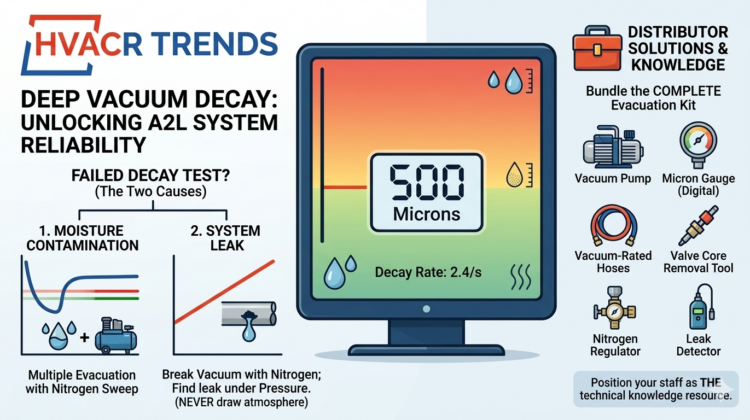
As the HVAC industry transitions toward A2L refrigerants and increasingly emphasizes installation quality, contractors are paying greater attention to evacuation procedures, moisture removal, and leak detection. Noted industry trainer Don Gillis, in his inaugural article for HVACRTrends, shares technical insights on the need for vacuum testing.
According to Don, the two primary causes of a failed vacuum decay test are moisture contamination and system leaks, and each requires a different corrective action.
The article explains that pulling a deep vacuum has long been considered a best practice, but it is becoming increasingly important—and in some applications required—as A2L refrigerants enter the market. Understanding how to interpret vacuum decay results allows technicians to determine whether a system is sufficiently dry and leak-free before charging it with refrigerant.
Why is this important for distributor? Two reasons:
- Technical knowledge for your staff, which translates into better insights and support for your customers.
- Sales and marketing ideas to position yourself as “the knowledge resource” in your market.
Vacuum: Moisture vs. System Leak

Evacuation helps remove contaminants, like moisture and non-condensable gases, from HVAC/R systems, especially ones that are put into service for the first time or put back into service after a repair. Even though pulling a deep vacuum has always been a best practice, it will be required for systems that use the new A2L refrigerants.
Before a system is ready to be charged with refrigerant, we must pull a deep vacuum on it to do a decay test. The rate at which our vacuum decays lets us know if our system is dry and tight enough to operate normally. Everything leaks a little, but the decay test sets a threshold that we don’t want to exceed. If our vacuum decays beyond that target, that means we have some problems we need to address.
If the leak rate has still not decreased, then one of two things may be happening:
- The system is still contaminated with moisture. (Possibly trapped under the compressor oil.)
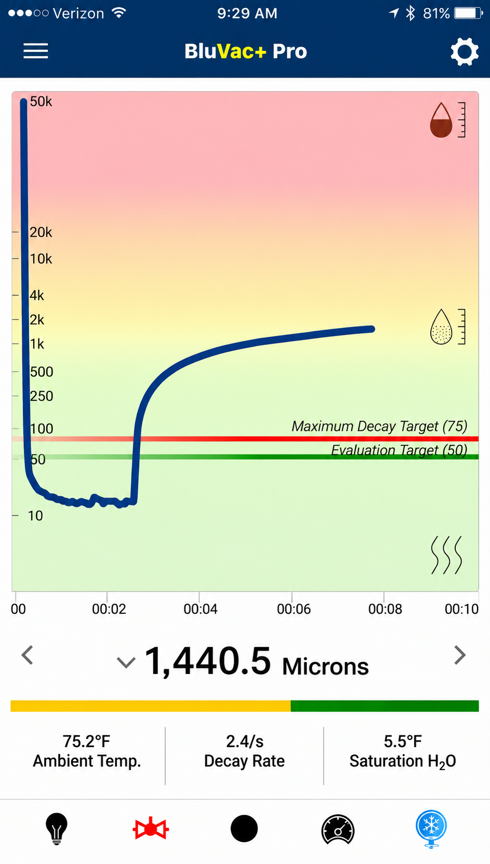
If the system indicates moisture, a multiple evacuation with a nitrogen sweep will significantly reduce the amount of moisture in the system.
Here is a step-by-step guide to the nitrogen sweep procedure:
- Reduce the system pressure to between 1000 and 2500 microns.
- Isolate the vacuum pump with the core tools and disconnect the vacuum hose from the low side of the system.
- Break the system vacuum with nitrogen introduced at the side port of the core tool.
- Break the vacuum with nitrogen to get it to the equivalent of atmospheric pressure (760,000 microns).
- Purge nitrogen through the system at 1–3 PSIG from the high to the low side, letting it vent out the open port of the core tool.
Do not pressurize the system. Typically, no more than a triple evacuation with a nitrogen sweep will be required.
- The system has a small leak that was not detected by the initial pressure test. (Some leaks are more apparent under vacuum than pressure.)
While the micron gauge is quite capable of picking up leaks, testing for a leak in a vacuum is not acceptable practice over a standing pressure test, as moisture is drawn into the system during the evacuation process. If you find you have a leak under vacuum, break the vacuum with dry nitrogen and try to find it under pressure.
DO NOT open the system to atmosphere under a vacuum! Doing so undermines all your time and effort to this point.
If the system has a leak, the vacuum gauge will continue to rise until atmospheric pressure has been reached. However, if the system is vacuum-tight but still contains moisture, the rise will level off when the vapor pressure equalizes in the system, typically between 20,000 and 25,000 microns between 72° and 80°F. At that point, that vacuum reading will become stable.
Note: a system that continues to level off at 3500–4500 microns may have turned system moisture to ice. Should this occur, the system temperature may have to be raised by an external heat source to get the moisture out of the system.)
Conclusion
The two main causes of a failed decay test are moisture contamination and system leaks, both with different fixes. They’ll also look a bit different if you’re using an app to keep track of your vacuum. (Wet systems level off above the decay threshold; leaky systems tend to have straight lines going well above that target.)
Leaky systems that manage to get past the nitrogen pressure test will need to be addressed just like any other leak you’d find in the pressure test. Again, we don’t use a deep vacuum for leak testing because the vacuum pump draws moisture into the system through the leaks when it creates a pressure differential. But a deep vacuum can show you that you have a leaky system, and it needs to be taken care of just like any other system leak found with bubbles or a nitrogen pressure test.
 Don Gillis is a licensed HVACR Journeyman under the International Mechanical Code and trainer with Gillis Coach. With more than three decades in the HVACR industry, Don brings real field experience, national training background, and a practical teaching style focused on helping technicians, contractors, and industry professionals build confidence and reduce mistakes. Share your thoughts with Don
What This Means for HVAC Distributors
While the technical focus of the article is on moisture removal and leak detection, distributors should view this content through a broader business lens.
Every installation, startup, compressor replacement, refrigeration repair, coil replacement, and refrigerant circuit service event creates demand for proper evacuation and testing procedures. Contractors who understand these procedures require specialized tools, training, and support.
The products associated with this process include vacuum pumps, micron gauges, digital vacuum monitoring systems, vacuum-rated hoses, core removal tools, nitrogen regulators, leak detectors, filter driers, and A2L-compatible service equipment. As contractors improve their evacuation practices, demand for these products will continue to grow.
Action Steps for Distributors
-
Educate Your Team
Counter personnel, outside sales representatives, and HVAC specialists should understand the difference between moisture contamination and system leaks. This knowledge enables them to recommend appropriate products and troubleshoot customer questions more effectively.
-
Use the Content as a Training Tool
Share this article with your customers through newsletters, social media channels, branch handouts, lunch ‘n learns sponsored by multiple manufacturers (the application approach is appreciated by customers and is perceived less as a “sales pitch), and contractor meetings. Build a marketing campaign around A2L readiness.
-
Create Solution-Based Selling Opportunities
Rather than selling individual products, bundle vacuum pumps, micron gauges, nitrogen regulators, hoses, and leak detection equipment into complete evacuation kits. This approach increases sales while helping contractors improve jobsite performance. And even if you don’t bundle it as a package to sell as such in your ERP or eCommerce system, make sure you are “suggestion selling” and marketing it as a bundle. Train your sales team to think this way.
-
Support the A2L Transition
Don’t insights reinforce that proper evacuation procedures will become increasingly important for A2L refrigerants. Distributors who provide both products and education become trusted resources.
Final Thoughts
Many HVAC distributors compete on inventory, pricing, and delivery. Fewer compete on technical expertise. Insights from experts such as Don provide an opportunity to move beyond transactional selling and become a valuable partner to contractors.
The technical lessons in vacuum decay testing ultimately translate into fewer callbacks, improved system performance, greater contractor confidence, and increased demand for specialized service tools. Distributors that leverage this information for customer education, product promotion, and A2L readiness initiatives can strengthen customer relationships while creating new revenue opportunities.
In today’s HVAC market, technical knowledge is becoming a competitive advantage. Distributors that use educational content like this to train employees and support customers will be better positioned to grow as installation standards and refrigerant technologies continue to evolve.
What products, or product categories, would you like Don to address?


Leave a Reply