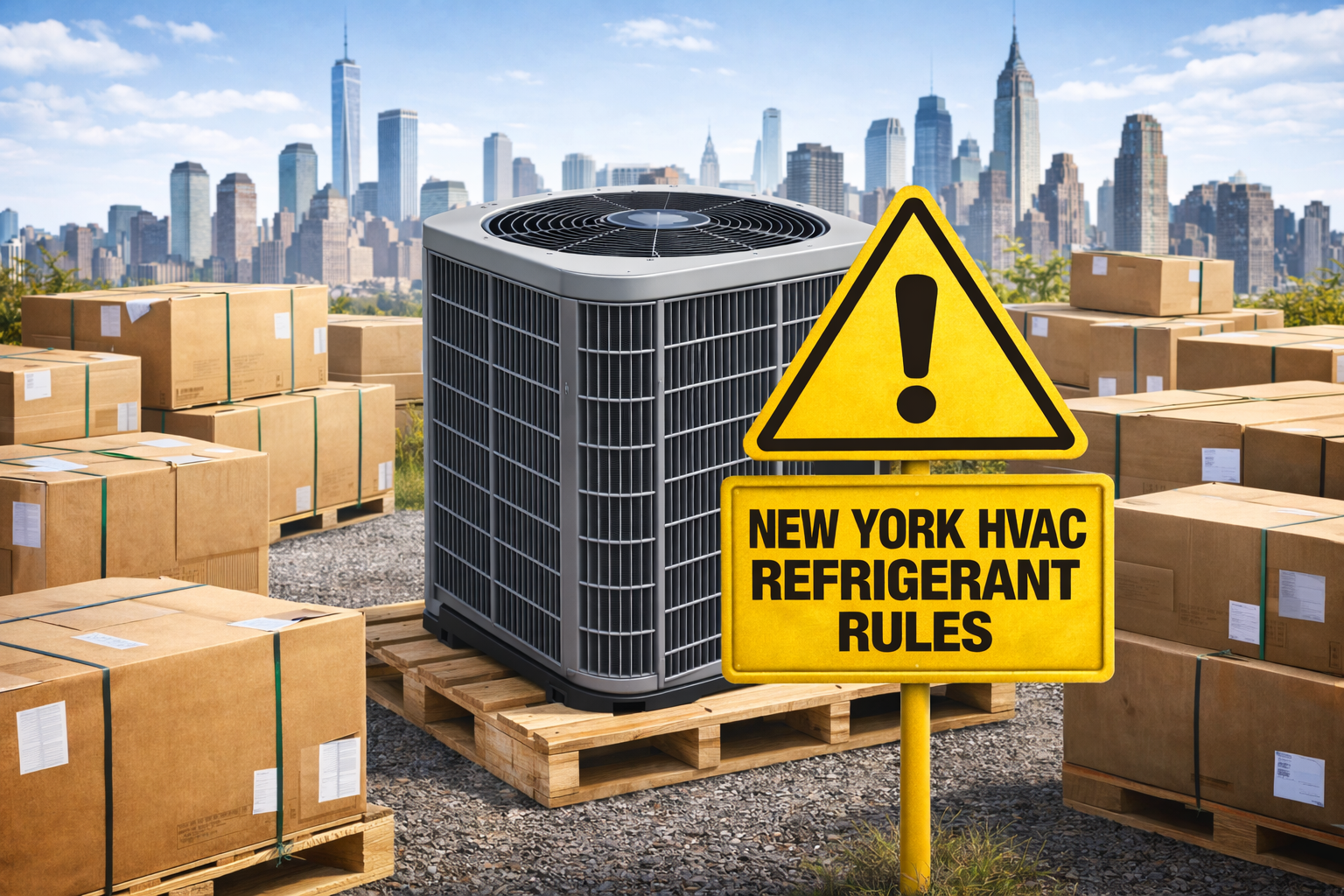
For much of the HVAC industry, New York HVAC refrigerant rules have hovered in an uncomfortable middle ground for several years. Not hypothetical, but not yet fully operational. Something people flagged in conference hallways, side conversations, and breakout sessions, including more than a few discussions at last year’s HARDI conference, but rarely addressed head-on.
That changed when recent court decisions and enforcement timelines made it clear that New York’s approach under Part 494 is no longer a future concern. It is a present one. The industry has crossed from monitoring to preparing, whether it feels ready or not.
Against that backdrop, a recent LinkedIn post from Christian Baca, Vice President of Sales and Marketing for Rheem Northeast Distribution, struck a nerve. Not because it introduced a new idea, but because it articulated a concern many distributors, contractors, and manufacturers have been quietly carrying for some time. His post did not create the alarm. It clarified why it exists.
An industry voice crystallizes the concern
Baca’s message was blunt and intentionally provocative, but the underlying issue he raised was not. He was reacting to a regulatory trajectory that increasingly appears misaligned with how HVAC equipment is designed, manufactured, distributed, installed, serviced, insured, and ultimately paid for.
Importantly, his concern was not ideological. It was operational. From the perspective of someone deeply embedded in the Northeast distribution ecosystem, the worry is not whether the industry can eventually adapt. It is whether the timelines and assumptions embedded in Part 494 reflect how supply chains actually change in the real world.
That distinction matters. Resistance to policy goals and concern about execution are not the same thing, yet they are often treated as such.
What actually changed under New York HVAC refrigerant rules (Part 494)
In December 2024, the New York State Department of Environmental Conservation adopted major amendments to 6 NYCRR Part 494. Those amendments became effective in early 2025. In December 2025, a New York Supreme Court decision rejected an industry challenge to the rule, leaving the regulatory framework intact.
The practical result is not legal ambiguity, but certainty of enforcement. Key dates now carry real operational consequences for manufacturers, distributors, and contractors doing business in New York.
Among the most consequential milestones are restrictions on the sale and installation of certain refrigerant-based equipment beginning in 2026, followed by progressively stricter global warming potential limits in subsequent years. Whether one agrees with the policy intent or not, the market now has clarity on direction, if not on execution.
Why “just a refrigerant change” misunderstands the problem
One of the most common refrains surrounding refrigerant regulation is that the industry has been here before. Refrigerants change. Efficiency standards evolve. The market adapts.
That framing misses the point.
HVAC systems are not standalone components. They are interconnected ecosystems. Changes at the refrigerant level cascade across equipment design, factory charging processes, certification timelines, distributor inventory strategies, contractor training requirements, local code enforcement, insurance underwriting, and liability frameworks.
For those closest to the supply chain, the concern is not the chemistry itself. It is the assumption that all of these interconnected systems will mature in parallel, on compressed timelines, without creating friction. Historically, they do not.
Regulation tends to move faster than supply chains can realistically adapt.
Short and medium-term supply chain friction
The concern around New York HVAC refrigerant rules is not rooted in long-term feasibility, but in short- and medium-term supply chain readiness. In the near and medium term, Part 494 introduces several predictable friction points.
Manufacturers face platform decisions about how many product variants to support, when to rationalize SKUs, and how to manage regional versus national offerings. Distributors face inventory displacement risks as compliant and non-compliant equipment diverge by state. Contractors face training requirements and service complexity that may outpace available resources.
None of this suggests permanent dysfunction. The HVAC industry has a long track record of adapting to change. The issue is timing. Rapid regulatory compression tends to produce volatility rather than smooth transitions, especially in a market as large and influential as New York.
The economic reality distributors and contractors will absorb
That volatility shows up economically long before it stabilizes technically.
Installed costs become harder to predict. Bid validity windows shrink. Project repricing risk increases. Service work grows more complex and time-intensive. Insurance carriers and underwriters begin reassessing risk models as new equipment classes and installation practices emerge.
The most significant cost is often not the headline price of equipment, but uncertainty itself. Distributors and contractors are forced to make decisions with incomplete information, shifting rules, and uneven market readiness. That unpredictability becomes a hidden tax absorbed throughout the channel.
Why New York HVAC refrigerant rules matter beyond New York
New York does not need to mandate national change directly to influence it. Markets of this size exert gravity.
When a large, complex market moves first, manufacturers often choose to rationalize product platforms nationally rather than fragment offerings state by state. That dynamic is familiar to anyone who watched how vehicle efficiency standards evolved over time. State-level action, combined with market scale, quietly reshapes national strategies.
Whether Part 494 ultimately produces that outcome remains to be seen. What is clear is that New York’s decisions will not remain neatly contained within its borders.
A reality check, not an anti-environment argument
None of this should be read as opposition to environmental progress. The HVAC industry has delivered meaningful gains in efficiency, emissions reduction, and system performance over the past decade.
The concern being raised by Baca and others is narrower and more practical. Ambitious policy goals require equally serious attention to execution timelines, infrastructure readiness, training capacity, and economic impact. Ignoring those factors does not accelerate progress. It distorts it.
What this means for the industry right now
The most immediate takeaway is that this conversation can no longer stay quiet.
Distributors, contractors, manufacturers, regulators, and policymakers all benefit from an honest discussion about how Part 494 will play out on rooftops, in mechanical rooms, and across supply chains, not just in regulatory filings.
HVAC is critical infrastructure. When regulatory ambition and operational reality drift too far apart, the consequences do not remain abstract. They show up in project delays, cost volatility, reduced service capacity, and real frustration for homeowners and businesses alike.
The alarm is not about change itself. It is about whether the path to change reflects how this industry actually works.


Leave a Reply