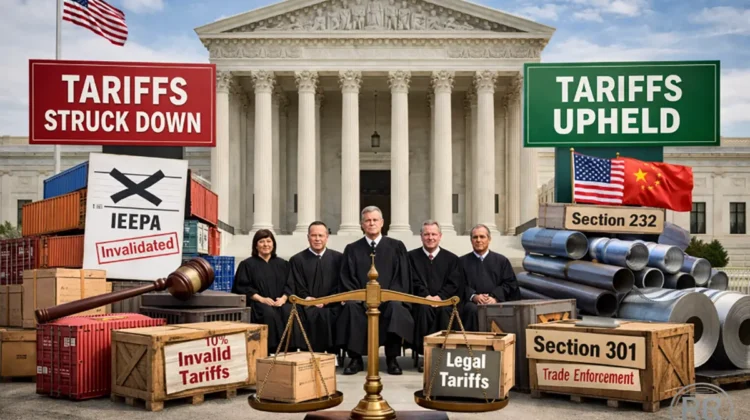
The Supreme Court handed down a significant trade policy decision last week, and the headlines made it sound like relief was on the way. For HVACR distributors, contractors, and manufacturers trying to manage HVAC tariff costs, the reality is more complicated than the news cycle suggests. The Court struck down one major tariff mechanism. Several others remain fully intact, a new one was imposed the same day, and prices on the materials that matter most to this industry have not budged.
What the Court Actually Decided
In Learning Resources, Inc. v. Trump, the Supreme Court ruled 6-3 that the International Emergency Economic Powers Act — IEEPA — does not authorize the president to impose tariffs. Chief Justice Roberts wrote the majority opinion, concluding that the Constitution’s taxing power belongs to Congress, not the executive branch, and that IEEPA’s language authorizing the president to ‘regulate importation’ does not extend to levying duties.
That ruling invalidated the broad reciprocal tariffs Trump had imposed on most trading partners starting in April 2025 — the so-called ‘Liberation Day’ tariffs — along with the fentanyl-related duties on Canada, Mexico, and China that were also issued under IEEPA authority. From a legal standpoint, it is a significant constraint on executive trade powers. From a channel economics standpoint, the picture is more nuanced.
What Stayed in Place — and Why It Matters for HVAC
The Supreme Court’s ruling did not touch tariffs imposed under other legal authorities, and those are the ones that hit HVACR hardest.
Section 232 tariffs — authorized under the Trade Expansion Act of 1962 on national security grounds — remain fully in effect on steel, aluminum, and copper. Those rates were increased to 50% in mid-2025 and have not changed. For HVACR, that is a direct hit. Copper tubing runs through virtually every refrigerant circuit in the industry. Aluminum coils sit in condensers and evaporators across every product category. Steel shows up in unit cabinets, ductwork, and structural components. These are not peripheral materials. They are the bill of materials.
Section 301 tariffs on Chinese imports — ranging from 7.5% to 25% depending on the product category — also remain in place. Electronic controls, sensors, motors, and finished equipment subassemblies sourced from China continue to carry those duties. For manufacturers with Chinese supply chain exposure, that cost has not changed.
HVAC Tariff Costs Are Not Going Away
ABC Chief Economist Anirban Basu noted that the IEEPA ruling would drive ‘a modest but meaningful reduction in materials price escalation’ for specialty equipment, HVAC and electrical systems and fixtures. That assessment reflects the narrow slice of HVACR pricing tied to IEEPA tariffs — mainly certain imported finished goods and components not covered by 232 or 301.
The word ‘modest’ deserves to be taken seriously. The AGC reports that construction input costs were up approximately 3.3% year-over-year through late 2025, with metals and imported products driving a significant portion of that increase. The metals tariffs driving that escalation are still running. SMACNA, which represents sheet metal and HVAC contractors, was direct in its post-ruling assessment: member firms are ‘still experiencing trade and tariff complications due to ongoing barriers and fees’ on metal suppliers, particularly from Canada.
On the distributor side, the cost picture is similarly unchanged in the near term. Inventory purchased at elevated prices is still on the shelf at elevated cost. The AGC cautioned its members not to expect retroactive pricing adjustments from suppliers. The same logic applies to HVACR distributors — what was bought at tariff-inflated pricing stays on the books at that cost until it sells through.
The Section 122 Wild Card
Within hours of the Court’s ruling, the administration moved to replace IEEPA tariffs with a new mechanism. Trump imposed a 15% global import surcharge under Section 122 of the Trade Act of 1974, effective February 24. This authority has a statutory cap of 150 days — the tariff expires July 24, 2026, unless Congress votes to extend it.
Section 122 does not apply to goods already covered by Section 232 tariffs, so steel, aluminum, and copper imports are not subject to the additional 15%. But for other imported HVACR goods — certain refrigerants, finished equipment, components not covered by 232 or 301 — the new surcharge fills part of the gap left by IEEPA.
The 150-day window creates its own planning challenge. Distributors and manufacturers making sourcing decisions now have to weigh what the policy environment looks like after July 24, which is genuinely uncertain. Congress could extend, the administration could pursue other trade authority, or the surcharge could simply lapse. That uncertainty is itself a cost — it shortens quote validity windows and complicates inventory planning across the channel.
Reading the Signal for the Channel
The practical read for HVACR channel partners is this: the Supreme Court ruling resolved a constitutional question about executive authority. It did not resolve the cost environment that distributors, contractors, and manufacturers have been navigating for over a year.
Distributors managing inventory should not expect supplier pricing adjustments driven by this ruling in the near term. Metals costs are the dominant input pressure, and those tariffs are unchanged. If anything, the Section 122 replacement tariff adds another layer of uncertainty on non-metal imports until mid-summer.
For contractors, the immediate implication is modest and confined to a narrow set of imported equipment categories. Labor costs remain the larger pressure — ABC estimates the industry needs more than 500,000 net new workers in 2026 to meet demand. The tariff story does not change that equation.
For manufacturers, the nuanced piece is understanding which of their imported inputs actually carried IEEPA tariffs versus 232 or 301 exposure. Some may see modest cost relief on finished imported goods or specific components. That depends entirely on the tariff classification of specific products, which varies by item and sourcing origin.
The headline said tariffs were struck down. The channel reality is that the tariffs doing the most damage to HVACR cost structures are still running. Planning for 2026 should proceed on that basis.
If this aligns with what you are seeing in your market, I would like to compare notes. CMG works with manufacturers, distributors, and rep firms who want clearer strategy, stronger channel performance, and better alignment across the field. If you are exploring ways to strengthen your commercial approach, reach out and let’s talk through what you are trying to build.


Leave a Reply